
The Central Board of Secondary Education (CBSE) has set the CBSE Class 12 Exam Pattern 2026-27 session. The pattern follows the National Education Policy (NEP) 2020. It aims to test how well you understand your subjects instead of checking only how much you can memorise.
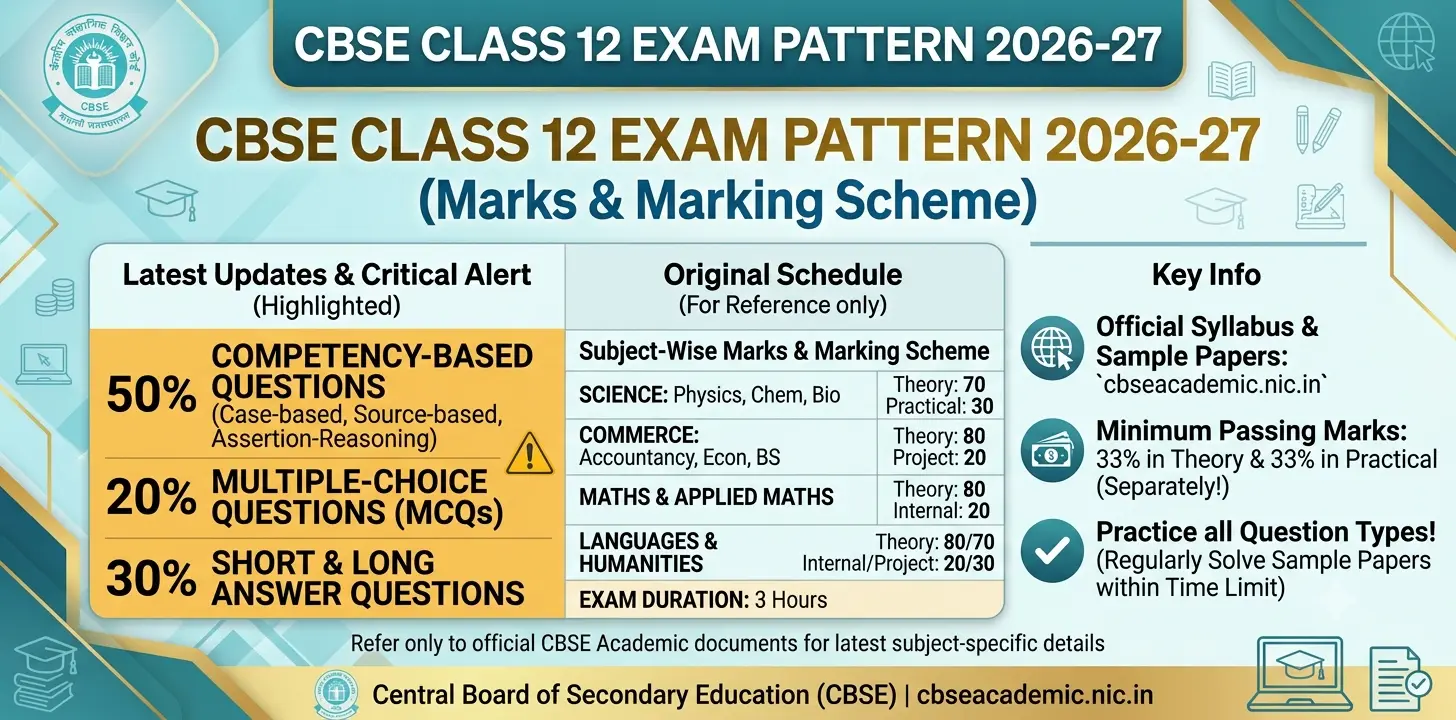
According to the exam pattern described here, 50% of the theory paper will have questions that test your understanding and use of what you have learned. These include case-based questions, source-based questions and assertion-reasoning questions.
Table of ContentsQuickly navigate to the information you need
The paper will also have 20% multiple-choice questions (MCQs). These questions will test your knowledge of facts, definitions and basic ideas. The remaining 30% will have short and long answer questions. These questions will test how well you can explain a topic and solve a problem step by step.
The marks for theory and practical or internal assessment depend on your subject. Some subjects have 70 marks for theory and 30 marks for practicals. Other subjects have 80 marks for theory and 20 marks for internal assessment.
You must score at least 33% marks in theory and at least 33% in practical or internal assessment separately, wherever both parts apply. You can check the subject-wise syllabus, marks and sample question papers on the official CBSE Academic website at cbseacademic.nic.in.
CBSE Class 12 Exam Pattern 2026-27: Subject-Wise Marks
The marks are not the same for every subject. Physics, Chemistry and Biology have practical exams. Subjects such as Accountancy, Economics and Business Studies include project work and viva. Mathematics, languages and Arts subjects have their own marking rules.
The table below gives the subject groups, theory marks, practical or internal marks and exam time mentioned in the CBSE Class 12 Exam Pattern 2026-27.
| Subject Group | Theory Paper Marks | Practical or Internal Assessment | Exam Duration |
|---|---|---|---|
| Science: Physics, Chemistry and Biology | 70 | 30 marks for practical exams, viva and experiments | 3 hours |
| Commerce: Accountancy, Economics and Business Studies | 80 | 20 marks for project work and viva voce | 3 hours |
| Mathematics and Applied Mathematics | 80 | 20 marks for internal assessment and Maths activities | 3 hours |
| Languages: English Core and Hindi | 80 | 20 marks: Listening 5, Speaking 5 and Project 10 | 3 hours |
| Humanities/Arts: History, Political Science and Geography | 70 or 80 | 20 or 30 marks for projects, map work or practicals | 3 hours |
As shown above, Science subjects have 70 marks for the theory paper and 30 marks for practical work. Commerce subjects, Mathematics and languages have 80 marks for theory and 20 marks for internal assessment in this general pattern. Humanities and Arts subjects may have 70 or 80 marks for theory, with 20 or 30 marks for other assessments.
The exam duration mentioned for all these subject groups is 3 hours. However, the exact marks and assessment rules may differ by subject. You should check the latest official CBSE documents for your own subjects.
CBSE Class 12 Theory Paper: Types of Questions
The theory paper has three main types of questions under the pattern described here. These are competency-based questions, multiple-choice questions and short and long answer questions.
1. Competency-Based Questions: 50% Marks
- Competency-based questions will carry 50% weightage. These questions check whether you understand a topic and can use what you have learned to answer a question.
- You may get case studies, passages, graphs or information from a given source. You may also get assertion-reasoning questions. Some questions will ask you to study the information and apply your knowledge to find the answer.
- For example, instead of asking you to write a definition from memory, a question may give you a real-life situation and ask you to use that concept. You must understand the topic to answer correctly.
- These questions test your thinking, understanding and problem-solving skills. So, when you prepare for the CBSE Class 12 Exam Pattern 2026-27, read your chapters carefully and practise questions based on what you have learned.
2. Multiple-Choice Questions (MCQs): 20% Marks
- Multiple-choice questions will carry 20% weightage. Each question has different answer options. You have to choose the correct answer.
- These questions may ask about definitions, facts and basic ideas. Some may test your ability to understand and compare information.
- Read the full question before choosing an answer. Do not select an option only because it looks familiar. Make sure it answers what the question is asking.
- You can practise MCQs from your textbooks and sample papers. This will help you become familiar with this type of question.
3. Short and Long Answer Questions: 30% Marks
- Short and long answer questions will carry 30% weightage. You have to write the answer yourself instead of choosing an option.
- Short answer questions may carry 2 or 3 marks. Long answer questions may carry 4 to 6 marks, depending on the subject and question paper. The paper may also include very short answer questions.
- Write your answers clearly. If a question asks you to explain something, include the main points. If you have to solve a Maths or Science problem, show the steps wherever needed.
- These questions test your knowledge and your ability to explain a topic in writing. Practise them regularly so that you can write complete answers within the exam time. CBSE Class 12 Exam Pattern 2026-27.
CBSE Class 12 Exam Pattern 2026-27: Full Question Paper Breakdown
The three types of questions have different weightages. Competency-based questions make up 50% of the paper. Standard MCQs make up 20%. Short and long answer questions make up the remaining 30%.
The competency-based part may include case-based questions, questions based on sources and passages, and assertion-reasoning questions. The MCQ part checks facts and basic concepts. The written-answer part includes very short, short and long answer questions.
Together, these three parts make up 100% of the theory paper under the pattern described here. You should practise all three types instead of preparing for only one.
CBSE Class 12 Exam Pattern 2026-27: Minimum Passing Marks
You must score at least 33% marks in the theory paper and at least 33% in practical or internal assessment separately, wherever both parts apply.
For example, Physics, Chemistry and Biology have 70 marks for theory and 30 marks for practical work in the subject-wise pattern listed above. You must meet the passing requirement for both parts.
For a subject with 80 marks for theory and 20 marks for internal assessment, you must also check the passing rules for each part. Do not look only at the combined total when checking whether you have passed.
Check the latest CBSE rules for your subject to confirm the exact passing requirements. CBSE Class 12 Exam Pattern 2026-27.
Where Can You Download the CBSE Class 12 Exam Pattern 2026-27?
You can visit the official CBSE Academic website at cbseacademic.nic.in. The website provides academic documents such as syllabi, sample question papers and marking schemes when they are available.
You can check these documents to learn which topics are included in your subject and how the questions may be set. The subject-wise marking scheme can also help you understand how marks are given for different answers.
Choose your own subjects and read the correct documents before you begin your final exam preparation. CBSE Class 12 Exam Pattern 2026-27.
How to Prepare for the CBSE Class 12 Board Exam
First, check your syllabus and make a study plan. Read each topic carefully and try to understand it instead of learning every answer by heart.
Practise case-based questions, source-based questions, assertion-reasoning questions and MCQs. Also, write short and long answers from your textbooks and sample papers.
For Maths and Science, practise problems and show all the required steps. For languages and other theory subjects, practise writing answers clearly and staying on the topic.
Try solving sample papers within the 3-hour exam time mentioned for the subjects listed above. After finishing a paper, check your answers and revise the topics where you made mistakes.
If your subject has practical exams, experiments, viva, projects, listening tests, speaking tests or map work, prepare for those parts too. Do not focus only on the theory paper. CBSE Class 12 Exam Pattern 2026-27.
Final Details About CBSE Class 12 Exam Pattern 2026-27
The CBSE Class 12 Exam Pattern 2026-27 described here has three main types of theory questions: 50% competency-based questions, 20% MCQs and 30% short and long answer questions.
The theory paper may carry 70 or 80 marks, depending on your subject. Practical or internal assessment may carry 20 or 30 marks. The exam duration listed for the subject groups is 3 hours.
You must meet the minimum passing requirement in theory and practical or internal assessment separately, wherever both apply. Check the official CBSE Academic website for the latest syllabus, sample papers and subject-wise marking rules before preparing for your board exams. CBSE Class 12 Exam Pattern 2026-27.
Also Check Out:- WBPSC Miscellaneous Result 2026 Out @psc.wb.gov.in, Download Miscellaneous Services 11/2023 Personality Test List PDF
FAQs
1. What is the CBSE Class 12 Exam Pattern 2026-27?
- The CBSE Class 12 Exam Pattern 2026-27 described in this article has three types of theory questions. Competency-based questions carry 50% weightage, multiple-choice questions (MCQs) carry 20%, and short and long answer questions carry 30%. Competency-based questions may include case studies, source-based questions and assertion-reasoning questions. Check the latest CBSE subject-wise documents to confirm the pattern for your subjects.
2. How many marks are there in the CBSE Class 12 theory and practical exams?
- The marks depend on your subject. Physics, Chemistry and Biology have 70 marks for theory and 30 marks for practicals in the pattern listed here. Accountancy, Economics, Business Studies, Mathematics and languages generally have 80 marks for theory and 20 marks for internal assessment. Humanities subjects may have 70 or 80 marks for theory and 20 or 30 marks for other assessments. The exam duration listed for these subjects is 3 hours. Check the official marking scheme for your subject.
3. What are the passing marks for CBSE Class 12 exams in 2026-27?
- Students must score at least 33% marks in theory and at least 33% in practical or internal assessment separately, wherever both parts apply. You should check the latest CBSE rules for your subject to confirm the passing requirements. Do not check only the total marks if your subject has separate theory and practical assessments.
4. Where can you check the CBSE Class 12 Exam Pattern 2026-27?
- You can visit the official CBSE Academic website at cbseacademic.nic.in. Check the syllabus, sample question papers and marking schemes for your subjects. These documents can help you understand the topics, question types and marks distribution. Practise MCQs, case-based questions and written answers, and prepare for practicals or project work if your subject includes them. CBSE Class 12 Exam Pattern 2026-27.
