
GSSSB Food Safety Officer Syllabus 2026: The Gujarat Subordinate Service Selection Board (GSSSB) has released the detailed notification for the GSSSB Food Safety Officer Recruitment 2026 under Advertisement No. 465/2026-27. The recruitment is being conducted for the post of Food Safety Officer, Class-3, under the Health and Family Welfare Department of the Government of Gujarat.
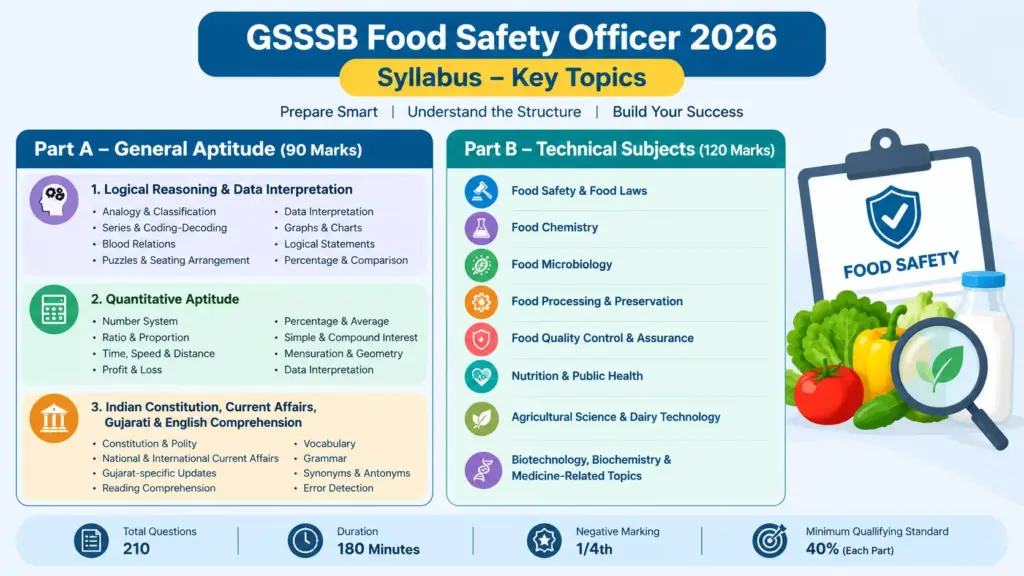
According to the official notification, the selection examination will be conducted in a single stage through an objective-type Multiple Choice Question (MCQ) examination using the Computer Based Response Test (CBRT) or Optical Mark Recognition (OMR) method. The question paper will consist of two parts: Part A and Part B.
Table of ContentsQuickly navigate to the information you need
GSSSB Food Safety Officer Syllabus 2026: Overview
Candidates preparing for the examination should understand the official exam pattern, general aptitude subjects, and the technical knowledge required for the Food Safety Officer post. Similar to the way the UPSC syllabus is organised into clearly defined subjects, this guide presents the GSSSB Food Safety Officer syllabus in a structured, subject-wise format to help candidates plan their preparation.
| Particulars | Details |
|---|---|
| Recruiting Authority | Gujarat Subordinate Service Selection Board (GSSSB) |
| Post Name | Food Safety Officer, Class-3 |
| Advertisement Number | 465/2026-27 |
| Total Vacancies | 84 |
| Examination Mode | CBRT/OMR |
| Question Type | Objective-type MCQs |
| Total Parts | Part A and Part B |
| Total Questions | 210 |
| Total Marks | 210 |
| Examination Duration | 3 hours (180 minutes) |
| Negative Marking | 1/4 of the marks assigned to a question for an incorrect answer |
| Minimum Qualifying Standard | 40% separately in Part A and Part B |
| Official Websites | gsssb.gujarat.gov.in and ojas.gujarat.gov.in |
Also Read: GSSSB Food Safety Officer Recruitment 2026: Apply Online for 90 FSO Posts
GSSSB Food Safety Officer Exam Pattern 2026
The GSSSB Food Safety Officer examination will be conducted in a single stage. The question paper is divided into two parts, with Part A covering general aptitude and language-related subjects and Part B testing knowledge related to the relevant technical discipline.
GSSSB Food Safety Officer Exam Pattern: Part A
Part A carries 90 marks and covers three broad subject groups.
| No. | Subject | Marks |
|---|---|---|
| 1 | Logical Reasoning and Data Interpretation | 30 |
| 2 | Quantitative Aptitude | 30 |
| 3 | Indian Constitution, Current Affairs, Gujarati and English Comprehension | 30 |
| Total | 90 |
GSSSB Food Safety Officer Exam Pattern: Part B
| Subject | Marks |
|---|---|
| Questions related to the relevant subject and its application | 120 |
| Total | 120 |
The notification states that the subject matter of Part B will be based on the prescribed educational qualifications for the post.
Important Points About the Examination
- The examination consists of a total of 210 questions across both parts.
- Part A carries 90 marks, while Part B carries 120 marks.
- Candidates receive a combined examination duration of 180 minutes.
- Negative marking applies to incorrect answers. One-fourth of the marks assigned to the relevant question will be deducted.
- Candidates must meet the minimum qualifying standard independently in both Part A and Part B.
- The prescribed minimum qualifying standard is 40% in each part.
Candidates should not prepare only for the general aptitude section. Since Part B carries the larger share of the marks, technical preparation should receive substantial attention.
GSSSB Food Safety Officer Syllabus 2026: Part A
Part A is divided into three sections: reasoning and data interpretation, quantitative aptitude, and a combined section covering the Constitution, current affairs, and Gujarati and English comprehension.
The following topic lists are suggested study areas within the official subject headings.
1. Logical Reasoning and Data Interpretation
This section assesses a candidate’s ability to understand information, identify patterns, interpret numerical data, and solve logical problems.
Important topics to prepare:
- Analogy and classification
- Number and alphabet series
- Coding and decoding
- Blood relations
- Direction and distance
- Ranking and order
- Syllogisms
- Logical statements and conclusions
- Venn diagrams
- Seating arrangements and basic puzzles
- Tables and charts
- Bar graphs and line graphs
- Pie charts
- Percentage-based data analysis
- Comparison of numerical information
- Data interpretation using averages and ratios
Preparation strategy: Practise MCQs regularly and focus on calculation speed, accuracy, and identifying the quickest method of solving a problem. Start with basic questions before moving to mixed reasoning and data interpretation sets.
2. Quantitative Aptitude
Quantitative aptitude tests numerical ability and mathematical problem-solving skills. Candidates should build a strong foundation in arithmetic before moving to more complex questions.
Important topics to prepare:
- Number system
- Simplification
- Fractions and decimals
- Ratio and proportion
- Percentage
- Average
- Profit and loss
- Discount
- Simple and compound interest
- Time and work
- Pipes and cisterns
- Time, speed and distance
- Problems on trains
- Mixtures and alligation
- Basic algebra
- Mensuration
- Basic geometry
- Data-based numerical calculations
These are suggested preparation topics under quantitative aptitude; the official notification lists the subject but does not provide an exhaustive chapter-wise breakdown.
Preparation strategy: Memorise essential formulas, practise timed problem sets, and maintain a notebook of calculation shortcuts and recurring mistakes.
3. Indian Constitution, Current Affairs, Gujarati and English Comprehension
This section combines general awareness, constitutional knowledge, and language comprehension. Candidates should prepare all four components rather than concentrating exclusively on current affairs.
A. Indian Constitution
Suggested topics include:
- Historical background and salient features of the Constitution
- The Preamble
- Fundamental Rights
- Fundamental Duties
- Directive Principles of State Policy
- Union and State governments
- President, Prime Minister, Governor and Chief Minister
- Parliament and State Legislatures
- Judiciary and the Supreme Court
- Constitutional bodies
- Centre-State relations
- Local self-government
- Constitutional amendments
- Important constitutional provisions
B. Current Affairs
Focus on recent national, international and Gujarat-related developments.
Suggested areas include:
- Important national and international events
- Government policies and schemes
- Gujarat government initiatives
- Important appointments and awards
- Science and technology developments
- Environment and biodiversity
- Agriculture and food-related developments
- Public health initiatives
- Important reports, indices and summits
- Food safety, nutrition and public health news
For this examination, candidates should pay particular attention to current affairs concerning food regulation, food adulteration, nutrition, agriculture, food processing and public health.
C. Gujarati Comprehension
Suggested areas include:
- Reading comprehension
- Understanding passages
- Vocabulary and word usage
- Synonyms and antonyms
- Sentence structure
- Grammar and language usage
- Identifying the central idea of a passage
D. English Comprehension
Suggested areas include:
- Reading comprehension
- Vocabulary
- Synonyms and antonyms
- Grammar
- Sentence correction
- Error identification
- Fill-in-the-blanks
- Sentence completion
- Understanding the meaning and context of a passage
The official notification groups Gujarati and English comprehension within Part A. Candidates should practise passages and language-based MCQs to improve both speed and accuracy.
GSSSB Food Safety Officer Syllabus 2026: Part B
Part B carries 120 marks and focuses on questions related to the relevant subject and its application. The official notification states that its content will be based on the prescribed educational qualifications.
The recruitment rules accept specified qualifications in fields such as Chemistry, Food Technology, Dairy Technology, Biotechnology, Oil Technology, Agricultural Science, Veterinary Science, Biochemistry, Microbiology and Medicine, subject to the applicable rules and recognised qualifications.
For effective preparation, candidates should study the technical subjects associated with their eligible discipline while also developing knowledge of food safety regulation and its practical application.
The following is an indicative technical preparation syllabus, not an officially published chapter-wise GSSSB syllabus.
1. Food Safety and Food Laws
Food safety legislation and regulatory procedures are directly relevant to the responsibilities of a Food Safety Officer.
Suggested topics:
- Food Safety and Standards Act, 2006
- Role and functions of the Food Safety and Standards Authority of India (FSSAI)
- Food Safety and Standards Rules and applicable regulations
- Food licensing and registration
- Food labelling and packaging requirements
- Food adulteration and misbranding
- Food hygiene and sanitation
- Food sampling and inspection
- Food testing and laboratory analysis
- Food business operator responsibilities
- Food recalls and enforcement procedures
- Food safety audits and compliance
- Penalties and legal provisions relating to food safety
Candidates should study the applicable provisions and regulations carefully, including amendments and current requirements.
2. Food Chemistry
Food chemistry deals with the chemical composition of food, its properties, and the changes that occur during processing, storage and preparation.
Suggested topics:
- Carbohydrates, proteins and lipids
- Vitamins and minerals
- Water activity and moisture content
- Food acidity and pH
- Enzymes in food
- Food additives and preservatives
- Natural and synthetic food colours
- Antioxidants
- Food oxidation and rancidity
- Chemical changes during food processing
- Food adulterants and contaminants
- Analytical methods used in food testing
Candidates with a Chemistry background should revise basic chemical principles and their application to food quality and safety.
3. Food Microbiology
Food microbiology is important for understanding contamination, food spoilage and foodborne diseases.
Suggested topics:
- Bacteria, viruses, yeasts and moulds
- Growth and multiplication of microorganisms
- Factors affecting microbial growth
- Food contamination and spoilage
- Foodborne pathogens
- Foodborne infections and intoxications
- Microbial food testing
- Sterilisation and pasteurisation
- Disinfection and sanitation
- Microbiological standards for food
- Cross-contamination and preventive measures
- Good hygiene practices
Candidates should understand how microorganisms enter food, the conditions that promote their growth, and the methods used to prevent foodborne illness.
4. Food Processing and Preservation
This area covers the methods used to process, preserve, store and transport food while maintaining its safety and quality.
Suggested topics:
- Principles of food processing
- Heat processing
- Pasteurisation and sterilisation
- Refrigeration and freezing
- Drying and dehydration
- Fermentation
- Canning
- Packaging methods
- Cold-chain management
- Storage conditions
- Shelf life and food deterioration
- Food preservation technologies
- Food processing hygiene
Focus on the principles, applications, advantages and limitations of each preservation method.
5. Food Quality Control and Quality Assurance
Food quality control involves assessing whether food meets applicable safety, compositional and quality requirements.
Suggested topics:
- Quality assurance and quality control
- Food sampling techniques
- Physical and chemical analysis of food
- Laboratory testing principles
- Standardisation and quality specifications
- Food adulteration detection
- Contaminants and residues
- Basic analytical chemistry
- Laboratory hygiene and safety
- Good Laboratory Practices
- Hazard Analysis and Critical Control Points (HACCP)
- Good Manufacturing Practices (GMP)
- Good Hygiene Practices (GHP)
- Traceability and documentation
Candidates should understand the difference between food safety and food quality, along with the role of preventive control systems in food production.
6. Nutrition and Public Health
Food Safety Officers work in an area closely connected with consumer health and nutrition.
Suggested topics:
- Balanced diet and essential nutrients
- Macronutrients and micronutrients
- Vitamins and mineral deficiencies
- Nutritional requirements
- Food fortification
- Food-related public health concerns
- Foodborne illnesses
- Food hygiene and personal hygiene
- Safe drinking water
- Food safety risks among vulnerable populations
- Nutrition labelling
- Public health measures for preventing foodborne diseases
Candidates should connect nutritional concepts with food quality, labelling, contamination prevention and consumer protection.
7. Agricultural Science and Dairy Technology
Candidates whose eligible qualifications are in Agricultural Science, Dairy Technology or related disciplines should revise the foundational concepts relevant to their academic background.
Suggested areas include:
- Agricultural produce and food quality
- Post-harvest handling and storage
- Milk composition and quality
- Milk processing and preservation
- Dairy product manufacture
- Food contamination during production and transport
- Animal-derived food products
- Hygiene in dairy processing
- Food storage and distribution
- Quality assessment of agricultural and dairy products
8. Biotechnology, Biochemistry and Medicine-Related Topics
Candidates from Biotechnology, Biochemistry, Microbiology and Medicine-related backgrounds can focus on foundational concepts that connect their academic knowledge with food safety.
Suggested areas include:
- Basic biochemistry
- Biological molecules and enzymes
- Microbial physiology
- Foodborne pathogens
- Toxins and biological contaminants
- Biotechnology applications in food
- Food safety testing
- Basic toxicology
- Public health and disease prevention
- Food contamination and its health effects
Candidates should prioritise subjects relevant to their qualifying discipline and avoid assuming that every topic listed here will necessarily appear in the examination.
How to Prepare for the GSSSB Food Safety Officer Examination
A systematic preparation plan should cover both parts of the examination. The UPSC-style approach of dividing a broad syllabus into subjects, using regular revision and practising mock tests can be adapted to this recruitment examination.
Step 1: Understand the Official Examination Structure
Begin with the notification and note the marks distribution:
- Part A: 90 marks
- Part B: 120 marks
- Total: 210 marks
Since Part B carries more marks, allocate a substantial portion of your study time to technical preparation without neglecting Part A.
Step 2: Prepare a Subject-Wise Study Plan
Divide the syllabus into manageable sections. Complete one topic at a time and revise previously studied subjects regularly.
For example, candidates may study quantitative aptitude and reasoning on alternate days, cover Constitution and current affairs throughout the week, and reserve dedicated daily sessions for technical subjects.
Step 3: Strengthen Technical Knowledge
Revise the fundamental concepts from your qualifying discipline. Pay special attention to food safety laws, food microbiology, food chemistry, food preservation and quality control where relevant to your background.
Use standard textbooks and authoritative regulatory resources. For legal and regulatory topics, refer to the latest applicable FSSAI materials rather than relying exclusively on old notes.
Step 4: Practise MCQs Regularly
Because the examination is objective-type, MCQ practice is essential.
Practise questions on:
- Reasoning and data interpretation
- Quantitative aptitude
- Indian Constitution and current affairs
- Gujarati and English comprehension
- Food science and food safety
- Technical concepts from your eligible discipline
After each practice session, review incorrect answers and identify the underlying concepts that need revision.
Step 5: Take Full-Length Mock Tests
Practise mock examinations under the prescribed 180-minute time limit. Full-length tests help you assess accuracy, time management and subject-wise performance.
Since there is negative marking, avoid guessing without sufficient confidence. Review your attempts and identify whether mistakes arise from weak concepts, calculation errors or misreading the question.
Step 6: Revise Food Safety Laws and Current Affairs
Keep a concise revision notebook for important laws, definitions, regulatory authorities, food safety standards and recent developments.
For current affairs, concentrate on developments that have a clear connection with the subjects covered in the examination.
Suggested 30-Day Preparation Plan
The following is an illustrative study schedule. Candidates should adjust it according to their existing knowledge, available time and technical background.
| Period | Preparation Focus |
|---|---|
| Days 1–5 | Reasoning, data interpretation and quantitative aptitude |
| Days 6–9 | Indian Constitution and current affairs |
| Days 10–12 | Gujarati and English comprehension |
| Days 13–20 | Technical subjects, food safety legislation and food science |
| Days 21–25 | Technical revision and subject-wise MCQ practice |
| Days 26–28 | Full-length mock tests and error analysis |
| Days 29–30 | Final revision of formulas, laws, definitions and weak areas |
This schedule is a preparation recommendation, not an official timetable. Candidates who need more time for technical subjects should extend that portion of the plan.
Important Preparation Tips
- Download and read the official GSSSB notification before beginning preparation.
- Give sufficient attention to Part B because it carries 120 marks.
- Do not ignore Part A, as it has a separate minimum qualifying standard.
- Revise basic concepts from your qualifying degree.
- Use topic-wise MCQs and mock tests to monitor progress.
- Read current food safety regulations and relevant official guidance.
- Practise completing the full paper within the allotted time.
- Avoid relying on an unofficial topic list as a substitute for the official notification or any subsequent syllabus clarification.
Frequently Asked Questions (FAQs)
Q1. What is the GSSSB Food Safety Officer Syllabus 2026?
The examination has two parts. Part A covers Logical Reasoning and Data Interpretation, Quantitative Aptitude, and Indian Constitution, Current Affairs, Gujarati and English Comprehension. Part B covers questions related to the relevant subject and its application.
Q2. How many questions are asked in the GSSSB Food Safety Officer examination?
According to the notification, Part A contains 90 questions and Part B contains 120 questions, making a total of 210 questions.
Q3. What is the total duration of the GSSSB Food Safety Officer exam?
The combined duration for Part A and Part B is 180 minutes, or three hours.
Q4. Is there negative marking in the GSSSB Food Safety Officer examination?
Yes. The notification specifies a deduction of one-fourth of the marks assigned to a question for an incorrect answer.
Q5. What is the minimum qualifying mark for the examination?
The notification prescribes a minimum qualifying standard of 40% separately for Part A and Part B.
Q6. Is the detailed Food Safety Officer syllabus officially available?
The notification provides the examination structure and states that Part B will be based on the prescribed educational qualifications. It does not provide a separate, exhaustive chapter-wise technical syllabus in the examination-pattern section. Candidates should check the official GSSSB website for any additional syllabus clarification.
Q7. Which subjects should candidates prioritise for Part B?
Candidates should begin with the fundamentals of their eligible academic discipline and revise relevant food safety legislation, food chemistry, food microbiology, food processing, food preservation and quality control. These are suggested preparation areas, not a confirmed list of every topic that will be tested.
Q8. Where can candidates check the official GSSSB Food Safety Officer notification?
Candidates can visit the official GSSSB website at gsssb.gujarat.gov.in or the OJAS Gujarat website at ojas.gujarat.gov.in for recruitment notices and updates.
Conclusion
The GSSSB Food Safety Officer Syllabus 2026 should be approached through a balanced preparation strategy covering general aptitude, language comprehension, constitutional awareness, current affairs and technical knowledge.
Candidates should understand the official 210-question examination structure, prepare for the separate qualifying standards in both parts, and devote adequate time to technical subjects relevant to their educational qualifications. Regular MCQ practice, revision and mock tests can help improve accuracy and examination readiness.
For the most reliable updates, candidates should refer to the official GSSSB notification and any subsequent notices published by the board.
