
Bharat Heavy Electricals Limited (BHEL) has announced the BHEL Engineer and Supervisor Trainee Recruitment 2026-27 for 415 vacancies. Candidates preparing for the Engineer Trainee examination should understand the latest syllabus, examination structure, marking scheme and selection procedure before starting their preparation. The BHEL Engineer Trainee selection process is expected to include a Computer-Based Test (CBT), followed by a Personal Interview for shortlisted candidates.
Table of ContentsQuickly navigate to the information you need
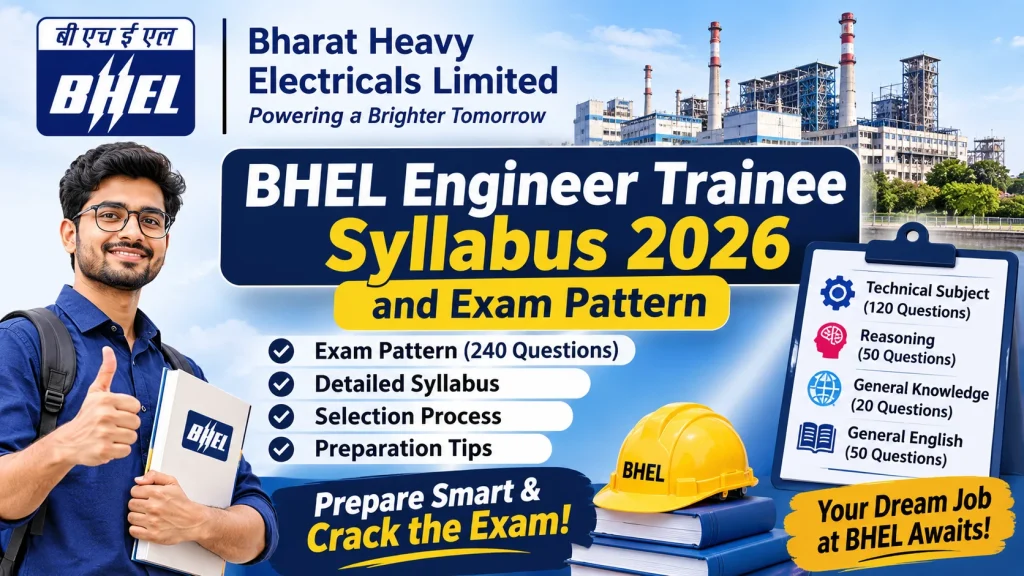
The BHEL Engineer Trainee CBT will assess candidates through technical and non-technical subjects, including General English, General Knowledge and Reasoning. The technical section will be based on the candidate’s relevant engineering or professional discipline. A clear understanding of the subject-wise syllabus will help candidates prioritise important topics, manage their preparation time and improve their examination performance.
In this article, candidates can check the BHEL Engineer Trainee Syllabus 2026, detailed exam pattern, discipline-wise technical syllabus, selection process, marking scheme and preparation guidelines.
BHEL Engineer Trainee Syllabus and Exam Pattern 2026: Overview
Candidates can check the important details of the BHEL Engineer Trainee examination in the following table.
| Particulars | Details |
|---|---|
| Organisation | Bharat Heavy Electricals Limited (BHEL) |
| Recruitment Name | BHEL Engineer Trainee Recruitment 2026-27 |
| Post Name | Engineer Trainee |
| Examination Mode | Computer-Based Test (Online) |
| Total Questions | 240 |
| Total Marks | 240 |
| Examination Duration | 150 minutes |
| Negative Marking | 1/4 mark (0.25 mark) |
| Examination Sections | Technical Subject, Reasoning, General Knowledge and General English |
| Selection Process | CBT and Personal Interview (as per recruitment process) |
| Official Website | www.bhel.com |
BHEL Engineer Trainee Selection Process 2026
The selection process for BHEL Engineer Trainee posts is designed to evaluate candidates’ technical knowledge, reasoning ability, general awareness and overall suitability for the position. The recruitment process comprises two major stages: a Computer-Based Test and a Personal Interview.
Candidates must qualify at the examination stage to become eligible for the subsequent selection round. The details of the selection stages are provided below.
1. Computer-Based Test (CBT)
The Computer-Based Test is the first stage of the BHEL Engineer Trainee selection process. The examination will consist of 240 objective-type questions carrying one mark each. Candidates will get a total of 150 minutes to complete the test.
The question paper will include technical questions from the relevant discipline along with questions on Reasoning, General Knowledge and General English. Candidates must obtain the required qualifying marks and meet the applicable merit criteria to be considered for the interview.
2. Personal Interview
Candidates shortlisted based on their CBT performance will be called for a Personal Interview. The interview shortlist is expected to be prepared in a ratio of 1:7 against the vacancies in each discipline and category.
During the interview, candidates may be evaluated on their technical understanding, subject knowledge, communication skills, problem-solving ability and suitability for the Engineer Trainee role.
The final selection will be made according to the applicable recruitment rules and merit criteria specified by BHEL.
BHEL Engineer Trainee Exam Pattern 2026
Understanding the examination pattern is essential for candidates planning to appear for the BHEL Engineer Trainee CBT. The question paper is divided into four sections, covering technical and general aptitude subjects.
The technical section carries the highest weightage, with 120 questions. The remaining questions assess reasoning ability, general awareness and English language proficiency.
Section-Wise BHEL Engineer Trainee Exam Pattern
| Section | Subject | Questions | Marks |
|---|---|---|---|
| I | Technical Subject | 120 | 120 |
| II | Reasoning | 50 | 50 |
| III | General Knowledge | 20 | 20 |
| IV | General English | 50 | 50 |
| Total | 240 | 240 |
Examination Duration: 150 minutes (as stated in the examination overview).
Important: The section-wise durations sometimes reproduced alongside this examination pattern should not be added together as separate examination times. The overall CBT duration is stated as 150 minutes. Candidates should verify the final section-wise timing instructions in the official examination notification or admit card.
Important Features of the Exam Pattern
- The examination will be conducted in online CBT mode.
- There will be 240 objective-type questions.
- Each correct answer carries one mark.
- The technical subject section contains 120 questions.
- Reasoning and General English contain 50 questions each.
- General Knowledge contains 20 questions.
- A negative marking of 0.25 mark is applicable for every incorrect answer, as indicated in the provided examination details.
- Candidates should carefully read the instructions displayed before starting the examination.
BHEL Engineer Trainee Syllabus 2026: Subject-Wise Details
The BHEL Engineer Trainee syllabus covers four major sections: Technical Subjects, Reasoning, General Knowledge and General English. Candidates should prepare all sections according to their respective weightage.
Below is the detailed topic-wise syllabus to help candidates organise their preparation.
1. BHEL Engineer Trainee Syllabus for General English
The General English section evaluates a candidate’s understanding of English grammar, vocabulary, sentence formation and reading comprehension. Candidates should focus on improving grammatical accuracy and developing the ability to understand passages quickly.
The important topics covered under this section include:
- Error Detection
- Fill in the Blanks
- Tenses and Verb Forms
- Prepositions and Articles
- Synonyms and Antonyms
- Spelling Correction
- Word Usage
- Idioms and Phrases
- Sentence Completion
- Sentence Structure
- Sentence Rearrangement
- Shuffling of Sentence Parts
- Reading Comprehension
- Vocabulary and Grammar
Preparation Tip: Candidates should regularly practise grammar exercises, vocabulary questions and reading comprehension passages. Solving previous competitive examination English questions can also help improve speed and accuracy.
2. BHEL Engineer Trainee Syllabus for General Knowledge
The General Knowledge section tests candidates’ awareness of important national and international developments, Indian history, geography, science, economics and other general awareness topics.
Candidates should maintain a balance between static General Knowledge and current affairs preparation.
The important topics are:
- Everyday Science
- Sports and Important Sporting Events
- Indian Culture and Heritage
- Ancient, Medieval and Modern Indian History
- Indian Geography
- World Geography
- Indian National Movement
- Indian Economy
- Indian Polity and Constitution
- National and International Current Affairs
- Environmental Studies
- Agriculture and Trade
- Basic Information Technology
- Important Government Schemes
- Awards and Honours
- Important National and International Organisations
Preparation Tip: Read current affairs regularly and revise important static GK topics. Special attention should be given to science, technology, the Indian economy and major national developments.
3. BHEL Engineer Trainee Syllabus for Reasoning
The Reasoning section evaluates candidates’ logical thinking, numerical ability, analytical skills and problem-solving approach. Candidates should practise different question patterns to improve their ability to solve problems within a limited time.
The major topics include:
Numerical Ability
- Number Systems
- Decimals and Fractions
- Percentage
- Ratio and Proportion
- Average
- Basic Mathematical Calculations
- Algebra
- Heights and Distances
- Arithmetic Progression (AP)
- Geometric Progression (GP)
- Number Series
Logical and Analytical Reasoning
- Analogy
- Similarities and Differences
- Classification
- Coding and Decoding
- Venn Diagrams
- Syllogism
- Logical Sequences
- Visual Memory
- Analytical Reasoning
- Judgment and Decision-Making
- Problem-Solving Ability
Preparation Tip: Practise topic-wise reasoning questions before attempting full-length mock tests. Focus on understanding the logic behind each question rather than memorising shortcuts.
4. BHEL Engineer Trainee Technical Syllabus 2026
The technical section is the most important component of the BHEL Engineer Trainee examination, accounting for 120 out of 240 questions. The syllabus depends on the discipline selected by the candidate.
For Engineering disciplines such as Mechanical, Civil, Electrical, Electronics, Chemical and Metallurgy, the technical syllabus is based on the AICTE Model Curriculum for Undergraduate Degree Engineering and Technology.
For Finance candidates, the syllabus is aligned with the CA/ICWA curriculum, while HR candidates should prepare according to the MBA-HR curriculum.
Candidates must select their preparation materials according to their applied discipline.
Mechanical Engineering Syllabus
Mechanical Engineering candidates should concentrate on core subjects related to thermal engineering, manufacturing, machine design, mechanics and fluid systems.
| Subject | Important Topics |
|---|---|
| Thermodynamics | Laws of thermodynamics, thermodynamic cycles, entropy and properties of steam |
| Fluid Mechanics | Fluid properties, Bernoulli’s theorem and flow through pipes |
| Strength of Materials | Stress, strain, bending moment, shear force and torsion |
| Theory of Machines | Kinematics, gears, flywheels and governors |
| Machine Design | Machine elements, shafts, bearings and joints |
| Heat Transfer | Conduction, convection, radiation and heat exchangers |
| Manufacturing Processes | Casting, welding, machining and metal forming |
| Engineering Mechanics | Force systems, equilibrium and friction |
| Power Plant Engineering | Thermal power plants, boilers and turbines |
| Industrial Engineering | Production planning, quality control and operations research |
Electrical Engineering Syllabus
Electrical Engineering candidates should focus on electrical machines, power systems, circuit analysis, electronics and control systems.
| Subject | Important Topics |
|---|---|
| Electrical Machines | Transformers, DC machines and induction motors |
| Power Systems | Generation, transmission, distribution and protection |
| Network Theory | Circuit laws, network theorems and AC circuits |
| Control Systems | Transfer functions, stability and system analysis |
| Power Electronics | Converters, inverters and controlled rectifiers |
| Electrical Measurements | Measuring instruments, errors and bridges |
| Electromagnetic Fields | Electric fields and magnetic fields |
| Analog Electronics | Diodes, transistors and amplifiers |
| Digital Electronics | Logic gates, Boolean algebra and digital circuits |
| Utilisation of Electrical Energy | Electric drives, illumination and electrical heating |
Civil Engineering Syllabus
The Civil Engineering syllabus covers structural engineering, construction materials, geotechnical engineering, transportation and environmental engineering.
| Subject | Important Topics |
|---|---|
| Strength of Materials | Stress, strain, bending and torsion |
| Structural Analysis | Beams, trusses, frames and deflection |
| RCC Design | Design of beams, slabs, columns and footings |
| Soil Mechanics | Soil properties, consolidation and shear strength |
| Fluid Mechanics | Fluid statics, fluid flow and hydraulics |
| Surveying | Levelling, traversing and surveying instruments |
| Building Materials | Cement, concrete, steel and construction materials |
| Transportation Engineering | Highway planning, pavement and traffic engineering |
| Environmental Engineering | Water treatment, wastewater and pollution control |
| Construction Management | Estimation, costing and project planning |
Electronics Engineering Syllabus
Electronics Engineering candidates should prepare circuit theory, semiconductor devices, digital systems, communication and signal processing.
| Subject | Important Topics |
|---|---|
| Network Theory | Network theorems and circuit analysis |
| Electronic Devices | Diodes, transistors and semiconductor devices |
| Analog Electronics | Amplifiers, oscillators and feedback |
| Digital Electronics | Logic gates, Boolean algebra and sequential circuits |
| Signals and Systems | Signal classification, transforms and system analysis |
| Communication Systems | AM, FM, digital communication and modulation |
| Control Systems | Stability, block diagrams and frequency response |
| Electromagnetic Theory | Fields, waves and transmission lines |
| Microprocessors and Microcontrollers | Architecture, instruction sets and interfacing |
| Measurements and Instrumentation | Sensors, transducers and measuring instruments |
Chemical Engineering Syllabus
Chemical Engineering candidates should give priority to thermodynamics, heat transfer, mass transfer, chemical reaction engineering and process calculations.
| Subject | Important Topics |
|---|---|
| Chemical Engineering Thermodynamics | Laws, properties and thermodynamic cycles |
| Fluid Mechanics | Fluid flow, pumps and pressure measurement |
| Heat Transfer | Heat exchangers and heat-transfer mechanisms |
| Mass Transfer | Diffusion, distillation and absorption |
| Chemical Reaction Engineering | Reaction kinetics and reactor design |
| Process Calculations | Material and energy balances |
| Mechanical Operations | Size reduction, filtration and separation |
| Process Control | Control systems and instrumentation |
| Process Equipment Design | Design fundamentals and equipment selection |
| Plant Design and Economics | Plant layout, costing and process economics |
Metallurgy Engineering Syllabus
Metallurgical Engineering candidates should focus on physical metallurgy, extractive metallurgy, materials science, iron and steel production and heat treatment.
| Subject | Important Topics |
|---|---|
| Physical Metallurgy | Phase diagrams, transformations and microstructures |
| Mechanical Metallurgy | Stress-strain behaviour, deformation and fracture |
| Extractive Metallurgy | Pyrometallurgy, hydrometallurgy and electrometallurgy |
| Metallurgical Thermodynamics | Thermodynamic principles and phase stability |
| Heat Treatment | Annealing, normalising, hardening and tempering |
| Materials Testing | Tensile, hardness, impact and fatigue tests |
| Iron and Steel Making | Iron production, steel making and refining |
| Non-Ferrous Metallurgy | Extraction and properties of non-ferrous metals |
| Corrosion | Corrosion mechanisms and prevention |
| Manufacturing Processes | Casting, welding and powder metallurgy |
Finance Discipline Syllabus
Candidates applying for Finance-related positions should prepare according to the relevant CA/ICWA curriculum.
Important areas for preparation may include:
- Financial Accounting
- Cost Accounting
- Management Accounting
- Financial Management
- Corporate Accounting
- Auditing
- Taxation
- Business Laws
- Corporate Finance
- Financial Analysis
- Budgeting and Cost Control
Candidates should refer to the applicable official discipline-wise syllabus for the prescribed topics.
HR Discipline Syllabus
The HR technical syllabus is based on the MBA-HR curriculum. Candidates should focus on human resource management, organisational behaviour, labour laws and industrial relations.
Important topics include:
- Human Resource Management
- Human Resource Planning
- Recruitment and Selection
- Training and Development
- Performance Management
- Compensation and Benefits
- Organisational Behaviour
- Industrial Relations
- Labour Laws
- Employee Welfare
- Strategic Human Resource Management
- Leadership and Motivation
- Human Resource Development
BHEL Engineer Trainee Technical Syllabus: Topic-Wise Preparation Priority
The following priority levels are suggested for preparation based on the importance of core subjects in the respective academic disciplines. These are study-planning recommendations and should not be treated as official BHEL topic-wise weightage or guaranteed question distribution.
Candidates should give sufficient attention to all topics mentioned in the prescribed syllabus.
Mechanical Engineering
| Topic | Preparation Focus |
|---|---|
| Thermodynamics | Laws, cycles, entropy and steam properties |
| Fluid Mechanics | Fluid properties, Bernoulli’s theorem and pipe flow |
| Strength of Materials | Stress, strain, bending and torsion |
| Theory of Machines | Kinematics, gears and governors |
| Machine Design | Shafts, bearings, joints and machine elements |
| Heat Transfer | Conduction, convection, radiation and heat exchangers |
| Manufacturing Processes | Casting, welding, machining and forming |
| Engineering Mechanics | Force systems, equilibrium and friction |
| Power Plant Engineering | Boilers, turbines and thermal power plants |
| Industrial Engineering | Production planning and quality control |
Electrical Engineering
| Topic | Preparation Focus |
|---|---|
| Electrical Machines | Transformers, DC machines and induction motors |
| Power Systems | Generation, transmission and protection |
| Network Theory | Circuit laws, theorems and AC circuits |
| Control Systems | Transfer functions and stability |
| Power Electronics | Converters, inverters and rectifiers |
| Electrical Measurements | Instruments, errors and bridges |
| Electromagnetic Fields | Electric and magnetic fields |
| Analog Electronics | Diodes, transistors and amplifiers |
| Digital Electronics | Logic gates and Boolean algebra |
| Utilisation of Electrical Energy | Electric drives and illumination |
Civil Engineering
| Topic | Preparation Focus |
|---|---|
| Strength of Materials | Stress, strain, bending and torsion |
| Structural Analysis | Beams, trusses and deflection |
| RCC Design | Beams, slabs, columns and footings |
| Soil Mechanics | Soil properties and shear strength |
| Fluid Mechanics | Fluid statics and hydraulics |
| Surveying | Levelling and traversing |
| Building Materials | Cement, concrete and steel |
| Transportation Engineering | Highways and pavement engineering |
| Environmental Engineering | Water treatment and wastewater |
| Construction Management | Estimation and project planning |
Electronics Engineering
| Topic | Preparation Focus |
|---|---|
| Network Theory | Circuit analysis and network theorems |
| Electronic Devices | Semiconductor devices and transistors |
| Analog Electronics | Amplifiers and oscillators |
| Digital Electronics | Logic gates and sequential circuits |
| Signals and Systems | Signal analysis and transforms |
| Communication Systems | Modulation and digital communication |
| Control Systems | Stability and frequency response |
| Electromagnetic Theory | Fields and transmission lines |
| Microprocessors and Microcontrollers | Architecture and interfacing |
| Measurements and Instrumentation | Sensors and transducers |
Chemical Engineering
| Topic | Preparation Focus |
|---|---|
| Chemical Engineering Thermodynamics | Laws and thermodynamic properties |
| Fluid Mechanics | Fluid flow and pumps |
| Heat Transfer | Heat exchangers and heat transfer |
| Mass Transfer | Diffusion, distillation and absorption |
| Chemical Reaction Engineering | Kinetics and reactor design |
| Process Calculations | Material and energy balances |
| Mechanical Operations | Filtration and separation |
| Process Control | Control systems and instrumentation |
| Process Equipment Design | Equipment design fundamentals |
| Plant Design and Economics | Plant layout and process economics |
Metallurgy Engineering
| Topic | Preparation Focus |
|---|---|
| Physical Metallurgy | Phase diagrams and microstructures |
| Mechanical Metallurgy | Deformation and fracture |
| Extractive Metallurgy | Pyrometallurgy and hydrometallurgy |
| Metallurgical Thermodynamics | Thermodynamics and phase stability |
| Heat Treatment | Annealing and hardening |
| Materials Testing | Tensile, hardness and fatigue tests |
| Iron and Steel Making | Iron production and steel refining |
| Non-Ferrous Metallurgy | Extraction of non-ferrous metals |
| Corrosion | Corrosion mechanisms and prevention |
| Manufacturing Processes | Casting and welding |
BHEL Engineer Trainee Syllabus PDF Download 2026
Candidates who want to prepare systematically can refer to the official BHEL recruitment notification and the relevant syllabus documents. The official website is the primary source for checking the prescribed examination pattern, discipline-wise eligibility and any updated examination instructions.
To download the relevant notification and syllabus information, follow these steps:
- Visit the official BHEL website at www.bhel.com.
- Open the Careers or Recruitment section.
- Find the BHEL Engineer and Supervisor Trainee Recruitment 2026-27 notification.
- Open the relevant recruitment advertisement.
- Check the examination scheme and discipline-specific syllabus.
- Download and save the official PDF for future reference.
BHEL Engineer Trainee Syllabus PDF: Refer to the official recruitment notification for the applicable syllabus and examination details.
Candidates should avoid relying entirely on unofficial syllabus PDFs, as the examination authority may issue revised instructions or additional clarification.
How to Prepare for the BHEL Engineer Trainee Exam 2026?
A well-planned preparation strategy can help candidates cover the technical and non-technical sections effectively. Since the technical section accounts for half of the total questions, candidates should allocate sufficient preparation time to their core discipline while maintaining regular practice in the remaining sections.
Here are some useful preparation strategies:
1. Understand the Complete Syllabus
Before beginning preparation, download the official recruitment notification and identify the subjects applicable to your discipline. Prepare a checklist of all topics and track your progress regularly.
2. Give Priority to Technical Subjects
Technical knowledge is essential for the Engineer Trainee examination. Revise undergraduate engineering fundamentals, important formulas, numerical problems and conceptual topics from your chosen discipline.
3. Practise Reasoning Questions Daily
Solve questions involving number series, coding-decoding, percentages, ratios, analogies, classification and logical reasoning. Regular practice will improve calculation speed and accuracy.
4. Improve English Language Skills
Read English passages, practise grammar exercises and revise vocabulary. Focus on error detection, sentence completion, synonyms, antonyms and comprehension.
5. Stay Updated with Current Affairs
Prepare important national and international events, government schemes, sports news, science and technology developments and economic updates.
6. Attempt Mock Tests
Take full-length mock tests to become familiar with the CBT format. Analyse incorrect answers, identify weak areas and work on improving time management.
7. Revise Important Formulas and Concepts
Maintain separate short notes for technical formulas, important definitions, reasoning shortcuts and General Knowledge facts. Regular revision can help improve retention.
Important Points to Remember Before the BHEL Engineer Trainee Examination
- Check the official examination notification for the latest syllabus.
- Select technical study materials according to the applied discipline.
- Give adequate attention to both technical and non-technical sections.
- Remember that incorrect answers attract negative marking.
- Practise questions within the prescribed examination time.
- Check the admit card for the final examination schedule and instructions.
- Keep checking the official BHEL website for recruitment-related updates.
