
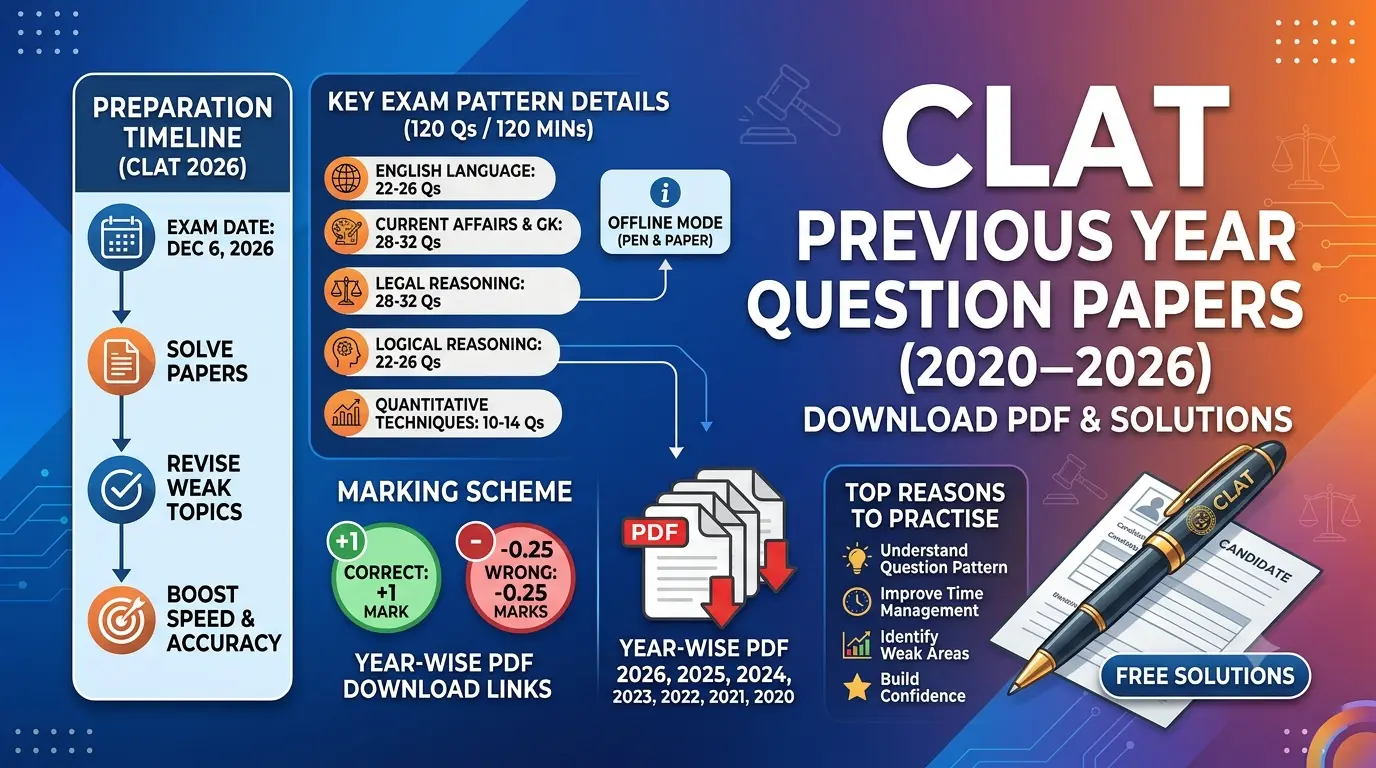
CLAT Previous Year Question Papers are useful for students preparing for the Common Law Admission Test. You can download past question papers and use them to practise for the exam. They help you understand the exam pattern, types of questions, marking scheme and difficulty level. Solving these papers also helps you improve your reading speed, accuracy and time management.
The Consortium of National Law Universities (NLUs) will conduct CLAT 2026 on December 6, 2026. Students who want to get admission to National Law Universities should use the remaining preparation time wisely. One way to prepare is to solve CLAT Previous Year Question Papers with answer keys and solutions.
Table of ContentsQuickly navigate to the information you need
These papers help you understand how questions are asked in the exam. You can also check your preparation level and find the topics that need more attention. Regular practice can help you feel more confident on exam day.
You can find CLAT question papers and answer keys through online education websites like Karmasandhan.com. This article provides year-wise PDF links, steps to download the papers, the exam pattern and useful preparation tips.
How to Download CLAT Previous Year Question Papers
You can download CLAT Previous Year Question Papers for different years, including 2026, 2025, 2024 and 2023. Follow these steps to get the papers from our website.
- Visit the CLAT Question Papers page on Karmasandhan.
- Find the question paper for the year you want to practise.
- Select the “Download” option beside the CLAT Question Paper with Answer Key link.
- Download and save the PDF on your device.
- Use the question paper to practise and check your answers with the answer key.
Try to solve the paper yourself before checking the answers. This will help you find out how much you have learned and which areas need more practice. CLAT Previous Year Question Papers.
CLAT Previous Year Question Papers with Solutions
You can use the following links to access CLAT Previous Year Question Papers. The links below include papers for 2023, 2024, 2025 and 2026.
| Question paper | PDF link |
|---|---|
| CLAT Previous Year Question Papers 2023 | Download Now |
| CLAT Previous Year Question Papers 2024 | Download Now |
| CLAT Previous Year Question Papers 2025 | Download Now |
| CLAT Previous Year Question Papers 2026 | Download Now |
Open the link for your preferred year to access the paper. Check the file details before starting your practice. If a link does not open or asks for permission, try the other question paper resources listed below.
CLAT Exam Pattern and Marking Scheme
Before you start solving CLAT Previous Year Question Papers, learn the exam pattern. This will help you understand how much time you have and how marks are awarded.
The exam is conducted offline using pen and paper. The pattern described below includes 120 questions and a total time of 120 minutes.
| Exam detail | Information |
|---|---|
| Exam mode | Offline, pen and paper |
| Total questions | 120 |
| Total marks | 120 |
| Exam duration | 120 minutes |
| English Language | Included |
| Current Affairs and General Knowledge | Included |
| Legal Reasoning | Included |
| Logical Reasoning | Included |
| Quantitative Techniques | Included |
The exam has five main sections. These test your reading skills, knowledge of current affairs, understanding of legal principles, reasoning ability and basic mathematical skills.
CLAT marking scheme
The marking scheme explains how your score is calculated.
- You get 1 mark for every correct answer.
- You lose 0.25 marks for every wrong answer.
- You get 0 marks for a question you leave unanswered.
Since wrong answers carry a penalty, you should avoid guessing without thinking. Practising CLAT Previous Year Question Papers can help you decide when to answer a question and when to leave it unanswered.
Always check the latest updates on the official CLAT website for any changes to the exam date, pattern or marking scheme. CLAT Previous Year Question Papers.
CLAT Exam Pattern: Section-Wise Marks
The table below shows the usual distribution of questions across the five sections. The number of questions in some sections is given as a range, so the exact distribution may vary.
| Section | Number of questions | Marks per question | Total marks | Approximate weightage |
|---|---|---|---|---|
| English Language | 22–26 | 1 | 22–26 | 20% |
| Current Affairs, including GK | 28–32 | 1 | 28–32 | 25% |
| Legal Reasoning | 28–32 | 1 | 28–32 | 25% |
| Logical Reasoning | 22–26 | 1 | 22–26 | 20% |
| Quantitative Techniques | 10–14 | 1 | 10–14 | 10% |
| Total | 120 | 1 | 120 | 100% |
English and Logical Reasoning together account for about 40% of the paper. Current Affairs and Legal Reasoning account for about half of the questions. Quantitative Techniques has a smaller share, but you should still practise it regularly.
Use this distribution as a guide while preparing. Check the latest official exam information before relying on it, as the pattern may change. CLAT Previous Year Question Papers.
Why You Should Practise CLAT Previous Year Question Papers
Reading books and notes is useful, but it is not enough on its own. You also need to practise answering questions. CLAT Previous Year Question Papers let you test what you have learned.
Here are some benefits of solving these papers.
1. Understand the question pattern
- Past papers show how questions are framed. They help you understand the type of passages and questions you may face in the exam.
- CLAT has a strong focus on reading and understanding information. Practising old papers can help you learn how to find the main idea, understand an argument and choose the best answer.
2. Improve reading speed
- Many questions are based on passages. You must read the passage, understand it and answer the questions within a limited time.
- Regular practice can help you read faster without missing important details. It can also help you avoid spending too much time on one difficult passage.
3. Learn time management
- You have 120 minutes to answer 120 questions under the exam pattern described above. This gives you an average of one minute per question.
- Some questions may take less time, while others may need more thought. Solving full papers with a timer helps you learn how to divide your time.
4. Find your weak areas
- After solving a paper, check which questions you answered incorrectly. Find out whether the mistake happened because you did not know the topic, misunderstood the passage or rushed through the question.
- Once you know the reason, revise that topic and practise similar questions.
5. Improve accuracy
- A wrong answer reduces your score by 0.25 marks under the marking scheme described above. You must therefore focus on both speed and accuracy.
- Reviewing answer keys can help you understand why an option is correct and why the other options are wrong.
6. Build confidence
- Solving full-length papers helps you become familiar with the exam conditions. You will also learn how to manage long passages and difficult questions.
- With regular practice, you may feel more comfortable when you sit for the actual exam.
7. Understand changes in the exam
- The CLAT question format has changed over the years. Older papers may contain question styles that are different from those used in more recent exams.
- Compare papers from different years to understand these changes. Give special attention to recent papers, particularly those from 2020 onward, when preparing for the current passage-based format.
What to Study in Each CLAT Section
CLAT Previous Year Question Papers cover five main sections. Each section tests different skills, so your practice should match the type of questions asked.
English Language
- This section checks your reading and understanding skills. Practise questions based on passages, the author’s main point, tone, arguments and conclusions.
- Do not just read the passage quickly. Make sure you understand what the author is trying to say.
Current Affairs and General Knowledge
- This section tests your awareness of current events and general knowledge. While practising, look at the background of an event as well as the basic facts.
- For example, try to understand why an event happened and why it matters. Regularly revise important national and international events.
Legal Reasoning
- This section tests how well you apply legal principles to a given situation. Read the principle carefully and then check how it applies to the facts in the passage.
- Practise identifying the connection between the rule and the situation described in the question.
Logical Reasoning
- This section checks your ability to understand arguments and find logical connections. Practise questions involving conclusions, assumptions, arguments, puzzles and syllogisms.
- Read every option carefully before selecting your answer.
Quantitative Techniques
- This section tests basic mathematical skills and the ability to understand numerical information. Practise questions involving percentages, ratios, tables, graphs and data interpretation.
- Work on your calculation speed, but make sure your answers are accurate.
When Should You Start Solving CLAT Previous Year Question Papers?
You do not have to wait until the final weeks before using previous year papers. Start with basic practice and increase the difficulty as your preparation improves.
Early stage
- First, learn the basic concepts and improve your reading skills. Become familiar with the CLAT syllabus and understand what each section covers.
- At this stage, you can solve a few questions to understand how they are framed.
Middle stage
- Once you have covered the basic topics, start solving questions from individual sections. Use CLAT Previous Year Question Papers to practise English, Legal Reasoning, Logical Reasoning, Current Affairs and Quantitative Techniques separately.
- Check your mistakes after each practice session.
Final stage
- In the final weeks, solve complete papers within the 120-minute time limit. Sit in a quiet place and avoid distractions.
- After each test, check your score, review your mistakes and revise the topics that need more work.
- You should continue practising until the exam. Regular practice is more useful than solving many papers without checking your answers.
How to Use CLAT Previous Year Question Papers Properly
Simply opening a PDF and looking at the questions will not improve your preparation. You need to solve the paper and learn from your mistakes.
Follow these steps to make your practice more useful.
Step 1: Set up an exam-like environment
- Choose a question paper and set a timer for two hours. Sit in a quiet place and keep your phone away.
- Try to follow the exam rules. Do not check the answer key while solving the paper. This will help you understand your actual preparation level.
Step 2: Attempt the questions yourself
- Read each passage carefully and answer the questions. Try to manage your time across all five sections.
- If a question is taking too long, move to another question and return to it later if time permits.
Step 3: Check the answer key
- After completing the paper, compare your answers with the answer key or solutions.
- Do not focus only on your final score. Check why each incorrect answer was wrong and why the correct option fits the passage or principle.
Step 4: Record your mistakes
- Write down the topics and question types where you lost marks. For example, you may have made mistakes in reading comprehension, legal principles, logical arguments or calculations.
- Keep a record of these errors so you can review them later.
Step 5: Revise the weak topics
- Go back to your notes and study the topics where you made mistakes. Practise similar questions before moving to another paper.
- This will help you avoid repeating the same errors.
Step 6: Solve the paper again
- After a few days, try the same paper again. Check whether you can answer the questions more quickly and correctly.
- You can also attempt it again after a few weeks to see how much you have improved.
Three Ways to Review Your Practice Papers
You can use the same CLAT Previous Year Question Papers for different types of practice. The key is to have a clear goal each time.
First attempt: Check your knowledge
- Solve the paper without looking at the answers. This will show which topics you already understand and which ones need more study.
Second attempt: Improve your speed
- After some time, solve the same paper again. Try to finish it more quickly while maintaining accuracy. You can set a target of finishing 15 minutes earlier, but do not rush if it leads to careless mistakes.
Third attempt: Review your reasoning
- Focus on the questions you got wrong earlier. Check whether you now understand the correct answer and whether your reasoning has improved.
- This method helps you identify whether your main problem is speed, accuracy or a lack of understanding.
Free CLAT Previous Year Papers: A Preparation Plan
You can organise your practice into four stages.
| Preparation stage | What you should do |
|---|---|
| Initial stage | Solve older CLAT papers from 2013 to 2024 to learn about question styles and topics. |
| Middle stage | Practise full-length papers under a 120-minute time limit. |
| Final weeks | Focus on speed, accuracy and mock tests. |
| Final revision | Reattempt difficult papers and review your mistake record. |
Do not try to complete every paper in a hurry. Give yourself enough time to understand the answers. You can change the order of the papers depending on your preparation level, but make sure you practise recent papers too.
How to Download CLAT Previous Year Papers from Karmasandhan
You can also look for past CLAT papers on our website “Karmasandhan.com”. Follow these steps.
- Visit the Karmasandhan Previous Year Papers page.
- Enter “CLAT” in the search bar.
- Click the search icon.
- Open the CLAT exam page or scroll down to find the available papers.
- Select the year you want to practise.
- Click the PDF download link.
Follow the instructions shown on the website. Some papers may open in an online viewer instead of downloading directly. Check that you have selected the correct year and course before you begin.
Common Mistakes to Avoid
Many students solve CLAT Previous Year Question Papers but do not review their performance properly. Avoid these common mistakes.
- Practising without a timer: You may not learn how to manage time during the actual exam.
- Ignoring the answer explanations: Checking only the score will not help you understand your mistakes.
- Skipping weak sections: Avoiding difficult topics can leave gaps in your preparation.
- Only reading notes: Reading is useful, but you must also practise answering questions.
- Solving a paper in parts every time: Try to complete full-length papers in one sitting so you can practise under exam-like conditions.
- Repeating papers without a goal: Each practice session should have a purpose, such as improving speed, accuracy or understanding.
Extra Practice Material for CLAT 2026
Along with previous year papers, you can use mock tests to practise different types of questions. Mock tests also help you check your preparation under timed conditions.
You can check the CLAT Practice Mock Booklet 2026 for additional practice material from the Official Website as well as from Our website.
Use mock tests and CLAT Previous Year Question Papers together. Past papers help you understand earlier exam questions, while mock tests give you more opportunities to practise.
Final Advice for CLAT Preparation
CLAT Previous Year Question Papers can play an important role in your preparation. They help you learn the exam pattern, understand the level of questions and improve your reading speed. They also show you which topics need more attention.
Start by learning the basic concepts. Then solve section-wise questions and move on to full-length papers. Check every mistake and revise the topics where you lose marks.
Do not depend only on the number of papers you solve. Focus on what you learn from each paper. Regular practice, careful review and proper time management can help you prepare better for CLAT 2026.
Before the exam, check the official CLAT website for the latest notice, exam date, pattern and other important updates.
Also Check Out:- UPPSC RO ARO Cut Off 2026: Check Previous Year Marks
FAQs
1. Where can you download CLAT Previous Year Question Papers?
- You can download CLAT Previous Year Question Papers from the links given in this article. Papers from 2013 to 2026 are listed, with links to resources from Karmasandhan.com. Choose the year and the correct UG or PG paper before downloading.
2. What is the CLAT exam pattern and marking scheme?
- As described in this article, CLAT is an offline exam with 120 questions for 120 marks. The duration is 120 minutes. The five sections are English Language, Current Affairs and General Knowledge, Legal Reasoning, Logical Reasoning, and Quantitative Techniques. You get 1 mark for each correct answer, lose 0.25 marks for each wrong answer and get no marks for an unanswered question. Check the official CLAT website for the latest exam pattern.
3. How do CLAT Previous Year Question Papers help in preparation?
- These papers help you understand the question types, exam pattern and difficulty level. They also improve reading speed, accuracy and time management. By checking your answers, you can find weak topics, learn from mistakes and decide which areas need more revision.
4. When should you start solving CLAT Previous Year Question Papers?
- Start by learning the basic concepts and understanding the syllabus. During the middle stage of preparation, solve questions from individual sections. In the final weeks, practise full-length papers within the 120-minute time limit. Check your mistakes after every test and revise weak topics regularly.
