
The Continuing Education Programme (CEP), IIT Delhi has launched a new Executive Certificate in Agentic AI Systems (Foundation to Deployment). This six-month online programme teaches working professionals how to design, build and deploy AI agents that can plan, use tools, remember context and work together to complete complex tasks.
The course is offered by IIT Delhi’s Department of Electrical Engineering, with TimesPro as the service provider. Classes for the first batch begin on 9 January 2027, and the last date to apply is 30 October 2026, so interested candidates have very little time left.
Table of ContentsQuickly navigate to the information you need
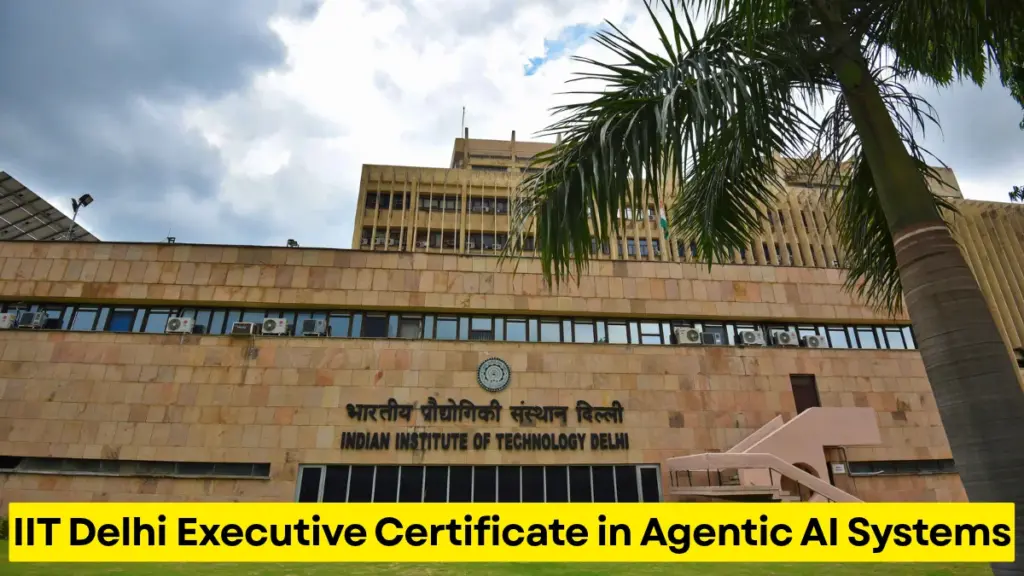
IIT Delhi Agentic AI Systems Course: Overview
Agentic AI is one of the fastest-growing areas in technology. Companies are moving beyond simple chatbots to AI systems that can act on their own, such as research assistants, customer-support workflows and software engineering agents. This programme covers the full journey: LLMs and prompt engineering, autonomous agents, retrieval-augmented generation (RAG), multi-agent orchestration, AI security and governance (AI TRiSM), and production deployment with LLMOps.
In this article, we cover the course details, schedule, fee and instalments, eligibility, curriculum, tools, projects, certification rules and how to apply.
| Particulars | Details |
|---|---|
| Programme Name | Executive Certificate in Agentic AI Systems (Foundation to Deployment) |
| Offered By | Continuing Education Programme (CEP), IIT Delhi |
| Organising Department | Electrical Engineering |
| Service Provider | TimesPro |
| Duration | 6 months |
| Mode | Online (live faculty-led sessions), with optional campus immersion |
| Class Schedule | Saturdays, 10:00 AM to 1:00 PM IST (subject to change) |
| Programme Fee | ₹1,45,000 + 18% GST |
| Application Fee | ₹1,000 + GST (non-refundable) |
| Eligibility | Graduates in science, engineering or commerce |
| Work Experience | At least one year preferred (optional) |
| Programme Coordinator | Prof. Sandeep Kumar, Department of Electrical Engineering, IIT Delhi |
| Official Website | cepqip.iitd.ac.in |
Also Read: IIM Calcutta MBA Admission 2027-29: CAT 2026 Cutoffs, Shortlisting and Final Selection Criteria
Important Dates
| Event | Date |
|---|---|
| Last date to apply | 30 October 2026 |
| First instalment due | Within 4 days of the offer letter |
| Programme start date | 9 January 2027 |
| Second instalment due | 3 February 2027 |
| Third instalment due | 3 March 2027 |
| Programme end date | 19 June 2027 |
Hurry: Applications close on 30 October 2026. Candidates who want to join the first batch should apply right away.
IIT Delhi Agentic AI Systems Curriculum
The programme starts with a pre-read module and then moves through nine core modules, each with hands-on demos.
| Module | Key Topics | Hands-on Demos |
|---|---|---|
| Pre-read | Python for data science, exploratory data analysis and visualisation, machine learning, deep learning basics | Self-paced |
| 1. Agentic AI Ecosystem | From generative AI to agentic AI, the agentic mindset, introduction to LangChain and LangGraph | First AI assistant (Streamlit), prompt playground (OpenAI), token and context explorer |
| 2. LLMs, Prompt Engineering and Intelligent Systems | LLM foundations, prompting techniques, LangChain LCEL, prompt security and injection defence | Email writer, resume improver, invoice data extraction, prompt injection defence |
| 3. Autonomous Agents | Agent lifecycle and state, tool use and function calling, Model Context Protocol (MCP), planning and memory | Weather agent, personal task agent, travel planning agent |
| 4. RAG, Memory and Knowledge Systems | Vector databases and similarity search, enterprise search, GraphRAG with SQL, APIs and real-time data | PDF Q&A with citations, enterprise knowledge assistant, SQL analytics agent |
| 5. Multi-Agent Systems and Orchestration | LangGraph state graphs, routing and checkpointing, multi-agent orchestration with LangGraph and CrewAI, handoffs and recovery | Research team agents, software engineering team, customer support workflow |
| 6. AI TRiSM (Trust, Risk and Security) | Governance frameworks, hallucination measurement, agentic security threats (data poisoning, model inversion), guardrail architecture | Prompt injection detection, hallucination evaluation (DeepEval), PII masking (Presidio) |
| 7. Prototype to Production | Agent APIs with FastAPI, LangSmith tracing and debugging, async APIs, streaming, WebSockets | FastAPI agent service, Streamlit web interface, Docker packaging |
| 8. LLMOps and Enterprise Operations | LangGraph Cloud deployment, CI/CD for LLM apps, prompt versioning, A/B testing, token budgeting and cost management | LangSmith tracing, cost and latency dashboard, multi-model routing with failover (LiteLLM) |
| 9. Assignments and Case Projects | Prompt engineering challenge, single autonomous agent, RAG pipeline, multi-agent workflow, context engineering | Graded assignments |
Projects and Capstone
Participants build several practical projects during the course, such as:
- AI email productivity assistant
- Meeting intelligence assistant
- Resume review assistant
- Enterprise document Q&A system
- Natural-language SQL analyst
The programme ends with an end-to-end capstone project: a complete agentic AI application that follows AI TRiSM (trust, risk and security) principles.
Tools and Technologies Covered
Python, NumPy, Pandas, OpenAI, Hugging Face, LangChain, LangGraph, LangSmith, LlamaIndex, CrewAI, AutoGen, FAISS, ChromaDB, Pinecone, MongoDB, PostgreSQL, FastAPI, Streamlit, Gradio, Docker, MLflow and GitHub.
Learning Outcomes
By the end of the course, participants should be able to:
- Design and deploy autonomous AI agents
- Orchestrate multi-agent systems using LangGraph, CrewAI and AutoGen
- Build enterprise knowledge systems with RAG and vector databases
- Apply responsible AI and AI TRiSM principles
- Build production-ready AI applications connected to enterprise data and APIs
- Monitor agent performance, safety and reliability
Eligibility Criteria
- Educational qualification: Graduates in science, engineering or commerce.
- Work experience: At least one year of professional experience is preferred but not compulsory.
- Selection: Applications are reviewed, and shortlisted candidates may be asked to take a faculty interview.
Who Should Join?
- AI and data science professionals who want to move into agentic AI
- Software developers and IT practitioners building AI-powered products
- Technology leaders and managers planning AI adoption in their organisations
- Science and engineering graduates looking to build a career in applied AI
Since the pre-read module covers Python, machine learning and deep learning basics, some familiarity with programming will help learners keep pace.
Fee Structure and Instalments
| Fee Component | Amount (excluding GST) | Amount with 18% GST | Due Date |
|---|---|---|---|
| Application fee | ₹1,000 | ₹1,180 | At the time of applying (non-refundable) |
| 1st instalment | ₹50,000 | ₹59,000 | Within 4 days of the offer letter |
| 2nd instalment | ₹50,000 | ₹59,000 | 3 February 2027 |
| 3rd instalment | ₹45,000 | ₹53,100 | 3 March 2027 |
| Total programme fee | ₹1,45,000 | ₹1,71,100 |
GST-inclusive amounts are calculated at 18% for reference. The application fee is not adjusted against the programme fee.
Refund Policy
- Withdrawal within 15 days of the programme start date: 80% of the fee paid (excluding taxes) is refunded.
- No refund after 15 days.
- Withdrawal requests must be emailed to the CEP accounts office and TimesPro. Refunds are processed within 30 working days.
Also Read: NTA Issues Advisory for JEE Main 2027 Session 1 Candidates, Check Details Now
Certification and Evaluation
Participants are assessed through quizzes, assignments, mid-term and end-term exams and the capstone project.
| Certificate | Requirement |
|---|---|
| Certificate of Successful Completion | At least 50% in evaluations and 70% overall attendance |
| Certificate of Participation | 70% attendance, but less than 50% in evaluations |
All certificates are e-certificates issued by CEP, IIT Delhi.
Programme Faculty
- Prof. Sandeep Kumar (Programme Coordinator): Associate Professor, Department of Electrical Engineering, IIT Delhi; associate faculty at the Yardi School of AI and the Bharti School of Telecommunication Technology & Management
- Prof. Tanmoy Chakraborty: IIT Delhi (natural language processing and small language models)
- Prof. Amrit Singh Bedi: University of Central Florida (AI alignment and RLHF)
- Prof. Ankita Shukla: University of Nevada, Reno (deep learning and AI for science)
- Prof. Manoj Kumar: IIT (ISM) Dhanbad (graph machine learning and federated learning)
How to Apply for IIT Delhi Executive Certificate in Agentic AI Systems
- Visit the CEP IIT Delhi website, cepqip.iitd.ac.in.
- Search for “Executive Certificate in Agentic AI Systems (Foundation to Deployment)” in the programme list.
- Click on Apply Now. You may be taken to the TimesPro application page.
- Register with your name, email ID and mobile number.
- Fill in your educational qualifications and work experience details.
- Upload the required documents, such as your degree certificate, photo ID and resume.
- Pay the application fee of ₹1,000 + GST online.
- Submit the form and save the confirmation.
- If shortlisted, attend the faculty interview (if required) and pay the first instalment within 4 days of receiving the offer letter.
FAQs
Q1. What is the duration of IIT Delhi’s Executive Certificate in Agentic AI Systems?
The programme runs for six months, from 9 January 2027 to 19 June 2027.
Q2. What is the last date to apply?
The last date to apply is 30 October 2026.
Q3. What is the fee for the IIT Delhi Agentic AI course?
The programme fee is ₹1,45,000 + 18% GST (about ₹1,71,100 in total), payable in three instalments. The application fee of ₹1,000 + GST is separate.
Q4. Who is eligible for this course?
Graduates in science, engineering or commerce. One year of work experience is preferred but optional.
Q5. Is the course online or offline?
The course is online, with live classes on Saturdays from 10 AM to 1 PM. An optional campus immersion is also offered.
Q6. Which tools will I learn?
LangChain, LangGraph, CrewAI, AutoGen, LlamaIndex, FAISS, ChromaDB, Pinecone, FastAPI, Docker, LangSmith, MLflow and more.
Q7. Will I get a certificate from IIT Delhi?
Yes. CEP, IIT Delhi issues an e-certificate. You need at least 50% in evaluations and 70% attendance for the Certificate of Successful Completion.
Q8. Is there a refund if I withdraw?
Yes. 80% of the fee paid (excluding taxes) is refunded if you withdraw within 15 days of the start date. There is no refund after that.
Q9. Who is the programme coordinator?
Prof. Sandeep Kumar of the Department of Electrical Engineering, IIT Delhi.
