
The ISC Class 12 Environmental Science Syllabus 2026-27 explains all the topics students must study for the 2027 board examination. The Council for the Indian School Certificate Examinations (CISCE) has divided the subject into seven units under three sections. These units cover human beings and nature, population growth, conservation, pollution, sustainable agriculture, environmental economics and international environmental issues.
Table of ContentsQuickly navigate to the information you need
The subject includes both theory and practical work. The theory paper carries 70 marks, while practical and project work carries 30 marks. Students should study every unit carefully and also complete the project work within the given guidelines.
In this article, you can check the complete ISC Class 12 Environmental Science Syllabus 2026-27, unit-wise topics, examination pattern, practical project details and the official PDF download link.
The official CISCE syllabus confirms that Environmental Science is subject code 877 for ISC Examination Year 2027. It also confirms the seven units, the 70-mark theory paper and the 30-mark practical/project paper. The detailed topics below follow the official syllabus, with the main points explained in easier language.
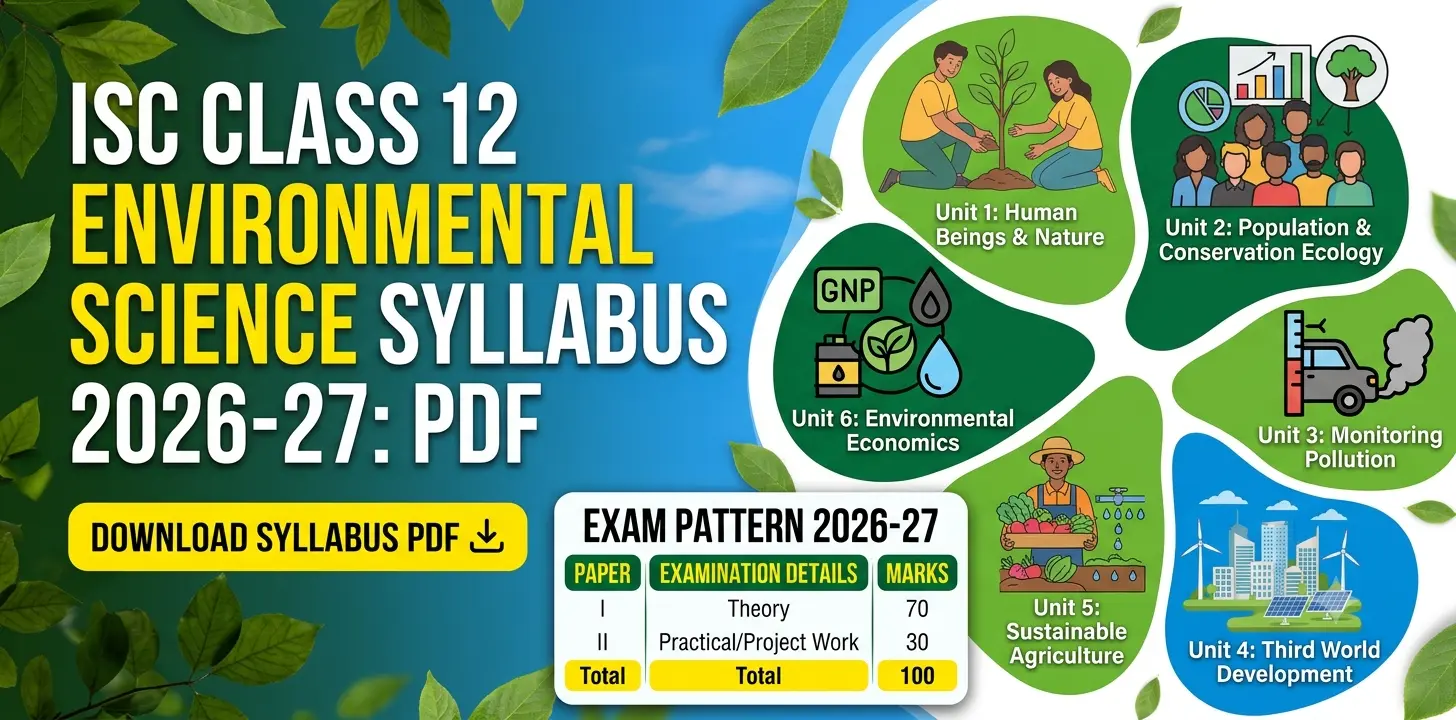
ISC Class 12 Environmental Science Exam Pattern 2026-27
CISCE has divided the Environmental Science examination into two papers. Paper I is the theory paper, and Paper II covers practical and project work.
The theory paper carries 70 marks and has a duration of 3 hours. Practical and project work carries the remaining 30 marks. Therefore, the total marks for the subject are 100.
| Paper | Examination details | Marks |
|---|---|---|
| Paper I | Theory – 3 hours | 70 |
| Paper II | Practical/Project Work | 30 |
| Total | Theory and practical/project work | 100 |
You should prepare for both papers. Do not focus only on the written examination. Your project work also carries 30 marks and forms an important part of the final assessment. ISC Class 12 Environmental Science Syllabus 2026-27.
Complete ISC Class 12 Environmental Science Syllabus 2026-27
The ISC Class 12 Environmental Science Syllabus 2026-27 has three sections: Section A, Section B and Section C. These sections contain seven units.
Section A includes Human Beings and Nature, Population and Conservation Ecology, and Monitoring Pollution. Section B covers Third World Development and Sustainable Agriculture. Section C includes Environmental and Natural Resource Economics and International Relations and the Environment. ISC Class 12 Environmental Science Syllabus 2026-27.
The following sections explain the topics included in each unit.
Section A
Unit 1: Human Beings and Nature
This unit explains the relationship between human beings and the natural world. You will learn about different ideas that explain how people should use, respect and protect nature.
The main topics include:
- Modern schools of ecological thought and their views about the relationship between human beings and nature.
- Deep Ecology and Shallow Ecology. Deep Ecology gives importance to nature and all living beings. Shallow Ecology mainly focuses on protecting nature to meet human needs.
- Stewardship of Land, including the ideas of Wendell Berry. It explains the responsible use and protection of land.
- Social Ecology, including Marxist environmentalism and Socialist Ecology. You will study the ideas of Barry Commoner.
- Feminism and Ecofeminism, including the connection between women and environmental protection.
- Green Politics and environmental political movements in countries such as Germany and England.
- Sustainable Development and its basic ideas. It means meeting present needs without reducing the ability of future generations to meet their own needs.
You will also study the work and ideas of three important environmental thinkers: Gary Snyder, Barry Commoner and Wendell Berry. Their work will help you understand different approaches to environmental protection. ISC Class 12 Environmental Science Syllabus 2026-27.
The syllabus also includes the work of some environmental organisations:
- Earth First: Its basic ideas, aims and environmental activities.
- World Wide Fund for Nature (WWF): Its organisation, mission and methods of protecting wildlife and nature.
- Greenpeace: Its mission, main values, objectives and environmental activities.
Unit 2: Population and Conservation Ecology
This unit explains how populations grow and change over time. It also covers the reasons behind population growth and the need to protect forests, wildlife and other natural resources. ISC Class 12 Environmental Science Syllabus 2026-27.
The topics included in this unit are:
1. Population Dynamics
You will study the factors that change the size of a population. These include births, deaths, immigration and emigration. You will also learn how these factors are connected.
Other topics include age structure, its importance and population pyramids. You will learn how to understand population pyramids and what they tell us about a population.
The syllabus also includes survivorship curves and r-selection and K-selection strategies. You will study their three general shapes and the differences between these strategies. ISC Class 12 Environmental Science Syllabus 2026-27.
2. Human Populations
This topic covers the Malthusian theory of population and the demographic transition model.
You will learn about carrying capacity and how it affects population growth. The Malthusian view explains the problems that may arise when population growth becomes faster than the availability of resources.
You will also study the idea of overpopulation, shortages of resources and questions raised about the Malthusian theory. The syllabus compares population growth with the unequal use of resources within and between countries.
The demographic transition model explains how population patterns change as a society develops. You will learn its meaning and the factors that influence this change. ISC Class 12 Environmental Science Syllabus 2026-27.
3. Population Regulation
This topic explains how the size of a population increases or becomes controlled.
You will study two important population growth patterns:
- Exponential growth or the J-shaped growth curve.
- Logistic growth or the S-shaped growth curve.
You will also learn about the factors that control population size. These include space, food, water, territory, predators, weather, climate, parasites, diseases, natural disasters and self-regulation.
4. Human Population Control
You will study different ways to control human population growth. These include family planning, education, economic growth and improving the status of women.
The syllabus gives special importance to women’s empowerment. You should understand how education, equal opportunities and better living conditions can help control population growth. ISC Class 12 Environmental Science Syllabus 2026-27.
5. Threats to Ecosystems
This topic explains the major problems that damage ecosystems. You will study habitat destruction, genetic erosion, loss of biodiversity, expanding agriculture, water storage projects, waste produced by human activities and increasing human consumption.
You should understand the causes and effects of these problems. The syllabus also covers how they affect the ability of ecosystems to provide resources and control natural processes.
6. Conservation
This topic explains why protecting forests, wildlife and other natural resources is necessary.
You will study the condition of Indian forests and the problems faced by people living in and around forest areas. These problems include conflicts over tribal rights, tourism, poaching, roads, dams and other development projects.
Other topics include scientific forestry and its limitations, social forestry, the role of forest departments and the work of NGOs. You will also study Joint Forest Management and the role of different organisations in protecting forests.
The syllabus covers wildlife sanctuaries, national parks and biosphere reserves. You will learn about their purpose and how they help protect wildlife. ISC Class 12 Environmental Science Syllabus 2026-27.
You must also understand two important methods of conservation:
- In-situ conservation: Protecting plants and animals in their natural habitats. Examples include national parks, wildlife sanctuaries and biosphere reserves.
- Ex-situ conservation: Protecting plants and animals outside their natural habitats. Examples include zoos, aquaria and plant collections.
Project Tiger is also included as a case study. You will study its beginning, aims, objectives, achievements and limitations.
Unit 3: Monitoring Pollution
This unit explains how pollution is identified, measured and controlled. It covers air, water and soil pollution, along with different methods used to check environmental quality.
The main topics are explained below.
1. Pollution Monitoring
You will learn the difference between primary and secondary pollutants. The syllabus explains why air pollution monitoring is necessary and how gaseous and particulate pollutants are measured.
You will also study the meaning of carbon credits and carbon trading. These methods are used to help control harmful emissions.
The unit covers the causes of excessive vehicle pollution and the steps taken to reduce it. These include emission standards for new vehicles, the CNG programme, vehicle inspection and maintenance, removal of old commercial vehicles and the use of public transport. ISC Class 12 Environmental Science Syllabus 2026-27.
2. Monitoring the Atmosphere
This topic explains how scientists monitor pollution at its source and measure the quality of the surrounding air.
You will learn about the selection of monitoring stations, the types and number of stations, the frequency of data collection and the basic requirements for air sampling. ISC Class 12 Environmental Science Syllabus 2026-27.
The syllabus covers two broad types of monitoring techniques:
- Manual techniques: Passive samplers, High Volume Samplers and Bubbler Systems.
- Instrumental techniques: NDIR and Chemiluminescence. You will study their basic principles and uses.
3. International and National Air Quality Standards
You will study air quality standards and why they are needed. The syllabus includes national air quality monitoring and the National Air Monitoring Programme (NAMP).
You will also learn about the main functions of the Central Pollution Control Board (CPCB) and State Pollution Control Boards (SPCBs).
The topic covers the objectives of air quality standards and the standards for gases and particulate matter, including their connection with WHO guidelines. ISC Class 12 Environmental Science Syllabus 2026-27.
4. Water Testing
This topic explains how the quality of water is checked. You will study different water quality indicators and understand what each one tells us.
The indicators include:
- Electrical conductivity
- Turbidity
- pH value
- Dissolved oxygen
- Faecal waste
- Temperature
- Hardness
- Nitrates
- Sulphates
You will also study the meaning of Biochemical Oxygen Demand (BOD) and Chemical Oxygen Demand (COD). These two topics are included for theoretical understanding. Laboratory work may be used to explain them, but it is not meant for testing. ISC Class 12 Environmental Science Syllabus 2026-27.
5. Soil Testing
You will learn how to check soil quality with the help of different indicators.
The syllabus includes three main types of soil indicators: biological, physical and chemical. You should understand the features of a good soil indicator and learn two examples of each type.
You will also study soil respiration, soil pH, soil aggregates and the infiltration rate. The topic includes their meaning, effects and basic experiments used to measure them. You should also learn simple methods to control or improve these soil conditions. ISC Class 12 Environmental Science Syllabus 2026-27.
Section B
Unit 4: Third World Development
This unit explains the connection between development, migration, urbanisation and environmental protection. It also examines how development can affect natural resources and people’s lives.
The main topics are:
1. Urban-Rural Divide
You will study urbanisation and the reasons why people move from villages to cities.
The syllabus explains push and pull factors. Push factors are problems that make people leave their homes, while pull factors are the facilities or opportunities that attract them to another place.
You will also study the effects of migration on rural and urban areas. The topic includes future trends, population changes and ways to reduce migration. ISC Class 12 Environmental Science Syllabus 2026-27.
2. Development and Sustainability
This topic examines the usual model of development from the viewpoints of sustainability, environmental impact and equal access to resources.
You will learn how development is often linked with economic growth. However, growth can also create environmental problems. ISC Class 12 Environmental Science Syllabus 2026-27.
The syllabus includes the following effects:
- Ignoring the harmful effects of development on nature.
- Changes in the use of natural resources because of market demand.
- Overuse and exploitation of natural resources.
- Use of limited resources to produce luxury goods instead of meeting basic needs.
- Unequal access to natural resources.
- Increasing waste and pollution.
You should understand these effects with suitable examples.
3. Gandhian Approach to Development
This topic explains Mahatma Gandhi’s ideas about village development and self-reliance.
You will study local self-government, village-based development, Antyodaya, Sarvodaya and Panchayati Raj. The syllabus also covers local markets, self-sufficiency and environmental protection.
Other topics include cottage industries, intermediate technology and the importance of employment. You should understand how the Gandhian approach differs from the modern model of economic growth. ISC Class 12 Environmental Science Syllabus 2026-27.
4. Urban Environmental Planning
This topic covers the environmental problems faced by towns and cities.
You will study problems related to sanitation, water management, transport, energy, air quality and housing. The syllabus also explains the economic and political difficulties that make these problems harder to solve.
You will learn about local solutions such as rainwater harvesting, waste segregation, composting, producing energy from solid and liquid waste, sewage management and dry toilets. Decentralised Wastewater Management Systems (DEWATS) are also included. ISC Class 12 Environmental Science Syllabus 2026-27.
The syllabus covers the basic ideas of New Urbanism and the goals of Smart Growth.
You must also study examples of environmental planning and management from different countries:
- Bogota, Bolivia: Traffic management.
- Cuba: Urban farming using organic methods.
- Curitiba, Brazil: Traffic planning and urban development through new methods.
- Cochabamba: Water management and protests against the privatisation of water supply.
Unit 5: Sustainable Agriculture
This unit explains how farming methods have changed over time. It also covers the importance of producing enough food without damaging soil, water and other natural resources. ISC Class 12 Environmental Science Syllabus 2026-27.
The main topics include:
1. Traditional Agriculture in India
You will study traditional farming methods used in India. These include irrigation systems, different crop varieties and methods of maintaining soil fertility.
The syllabus also covers the effects of British rule on Indian agriculture. You will learn about the condition of agriculture before colonial rule, during colonial rule and after independence.
Other topics include food shortages at the time of independence, food imports, the need to increase food production and the need for land reforms.
You will also study the meaning of traditional agriculture, natural farming, organic agriculture, modern agriculture, gene revolution and sustainable agriculture. ISC Class 12 Environmental Science Syllabus 2026-27.
2. Irrigation Systems
You will learn about large and small irrigation systems.
The topics include canal irrigation, dams, sprinkler irrigation, drip irrigation, trickle drip systems and dug wells. You should understand their main features, advantages and disadvantages.
Traditional rainwater harvesting methods are also included. These include tanks, khadins, ahar, pynes, zings, johads and eris. You should know where these methods are suitable and how they are used. ISC Class 12 Environmental Science Syllabus 2026-27.
3. Agriculture Before and During British Rule
The syllabus explains the main features of farming in India before British rule. Farmers mainly produced food for their own needs. They also used mixed cropping, maintained soil health and grew different types of seeds.
You will study how British rule changed Indian agriculture. Important topics include heavy taxation, the growth of commercial crops for export and the decline of traditional farming methods.
The Bengal famine is also included. You should understand the differences between pre-colonial, colonial and post-colonial agriculture and their effects. ISC Class 12 Environmental Science Syllabus 2026-27.
4. Green Revolution
This topic explains why the Green Revolution began in India. You will study the problems of food shortage and food imports, along with the need to increase agricultural production.
The syllabus includes the main features of the Green Revolution:
- High-Yielding Varieties (HYV) of seeds.
- Use of chemical fertilisers.
- Use of pesticides.
- Large irrigation projects and dams.
- Monocropping.
You will also study the environmental, social and economic effects of the Green Revolution. These include its effects on crop diversity, soil health, pesticide pollution, energy use and farming costs.
The syllabus also examines how the Green Revolution affected small and medium farmers and food security at household and community levels. ISC Class 12 Environmental Science Syllabus 2026-27.
5. Land Reforms
You will learn why land reforms were needed in India. The topic includes their advantages, successes and failures.
6. Methods of Sustainable Agriculture
This topic explains how farmers can produce food while protecting the environment.
You will study the following methods:
- Mixed farming and mixed cropping.
- Intercropping and crop rotation.
- Organic fertilisers and biofertilisers.
- Green manure.
- Biopesticides.
- Integrated Pest Management (IPM).
- Sustainable methods of managing soil, water and pests.
- Eating locally produced food.
You should understand how these methods help improve soil fertility, reduce the use of harmful chemicals and protect natural resources. ISC Class 12 Environmental Science Syllabus 2026-27.
7. Management of Agricultural Produce
This topic explains how food is stored, preserved and transported.
You will study different food preservation methods, including low temperatures, high temperatures, drying, canning and the use of salt and sugar.
The syllabus also includes food processing, packaging, grading and transportation.
You will learn the meaning of food adulteration and food additives. The topic covers different types of adulteration and their harmful effects. ISC Class 12 Environmental Science Syllabus 2026-27.
You should also know about these quality marks:
- ISI – Indian Standards Institution.
- AGMARK – Agricultural Marketing.
- FPO – Fruit Products Order.
8. Food Security
This topic explains the two main challenges of food security: producing enough food and making sure that people can access it.
You will study the food situation around the world and the meaning and need for food security.
The syllabus covers problems related to food production, storage and access. It also explains how an integrated and sustainable food system can help developing countries.
Other topics include land reforms, credit support for farmers, market support, problems in the existing marketing system, ways to improve food distribution and access, and ownership of seeds.
You should also understand that having enough food at the national level does not always mean that every household and community has enough food. ISC Class 12 Environmental Science Syllabus 2026-27.
Section C
Unit 6: Environmental and Natural Resource Economics
This unit connects economics with environmental protection. It explains how natural resources are used, valued and managed.
The main topics include:
1. Resources, Scarcity and Growth
You will study the meaning of natural resources and why some resources become scarce.
The syllabus covers different ways to classify natural resources:
- By origin: Biotic and abiotic resources.
- By renewability: Renewable and non-renewable resources.
- By development: Potential and actual resources.
- By distribution: Ubiquitous and localised resources.
You will also learn about natural resource accounting. This includes physical accounting, its basic principles, advantages and disadvantages. ISC Class 12 Environmental Science Syllabus 2026-27.
2. GNP and Other Ways of Measuring Income
This topic explains the difference between Gross Domestic Product (GDP) and Gross National Product (GNP).
You will learn what these terms mean and how they are used to measure economic growth. The syllabus also covers the advantages and limitations of using GDP and GNP for this purpose. ISC Class 12 Environmental Science Syllabus 2026-27.
3. Economic Welfare and Natural Capital
You will study the connection between economic activities, the environment and human welfare.
The topic includes environmental economics, net economic welfare, natural capital and ecological capital. You will also learn about defensive expenditure and its different types.
4. Externalities and Cost-Benefit Analysis
This topic explains how an economic activity can affect people and the environment.
You will study positive and negative externalities and their effects on society and nature.
The syllabus also covers cost-benefit analysis. It means comparing the expected costs and benefits of a decision. You should understand its basic process, advantages and disadvantages.
Extended Producer Responsibility (EPR) is also included. You will learn its meaning, examples and advantages. ISC Class 12 Environmental Science Syllabus 2026-27.
5. Natural Capital Regeneration
Natural capital refers to the resources and natural systems that provide benefits to people and support life.
You will study different types of natural capital and ecosystem services. The syllabus also covers the causes of environmental damage, such as acid deposition, air pollution, deforestation, biodiversity loss and carbon dioxide emissions.
Other topics include ecological footprint and the excessive use of natural resources by human beings.
You should understand why natural capital must be protected and restored for the future. ISC Class 12 Environmental Science Syllabus 2026-27.
Unit 7: International Relations and the Environment
This unit explains how environmental problems can affect more than one country. It also covers the role of international trade, politics and cooperation in protecting the environment.
The main topics are:
1. International Environmental Issues
You will study environmental problems that cross national borders. The syllabus includes three important case studies:
- Amazonia: Reasons for the exploitation of the Amazon forests, causes of deforestation, the effects of government policies, the importance of rainforests and possible solutions.
- Wildlife Trade: The ivory trade in Africa, reasons behind its growth in the past, steps taken to control it and the effects of banning the trade.
- Ozone Layer Depletion: The meaning of the ozone layer, how it gets damaged and the possible effects of ozone depletion.
For the ozone layer, you will also study Chapman’s cycle, the ozone hole and substances that damage the ozone layer. These include halons, carbon tetrachloride, CFCs, methyl chloroform, methyl bromide and HCFCs. Their life span in the atmosphere and steps taken to control ozone depletion are also included. ISC Class 12 Environmental Science Syllabus 2026-27.
2. International Politics and Environmental Protection
This topic explains how national interests, political decisions and the right of a country to govern itself can affect environmental policies.
You will study the role of national sovereignty and different countries’ interests in international environmental decisions. ISC Class 12 Environmental Science Syllabus 2026-27.
3. International Trade and the Environment
You will learn about international trade and its effects on natural resources and the environment.
The syllabus includes free trade, protectionism, import barriers and the relationship between domestic industries and international trade.
You will also study the history of transnational companies and how colonial trade patterns continue to affect developing countries. ISC Class 12 Environmental Science Syllabus 2026-27.
Other topics include:
- Trade between developed and developing countries.
- The terms of trade and their effects.
- India’s international trade, including major imports and exports.
- Foreign exchange crises and the need to increase exports.
- Environmental effects of export-based production.
- Aquaculture in India and its connection with free trade.
- Use of limited resources for commercial products instead of basic needs.
- Trade in toxic waste and its effects on developing countries.
- Globalisation and international trade rules.
You will study the World Trade Organization (WTO), General Agreement on Tariffs and Trade (GATT) and Intellectual Property Rights (IPR).
The syllabus also explains how trade can affect food security, economic welfare and environmental protection in developing countries. ISC Class 12 Environmental Science Syllabus 2026-27.
4. GATT and WTO
You will learn about the origin of GATT and how it later developed into the WTO.
The topic covers the main principles and functions of the WTO. These include Most Favoured Nation (MFN), National Treatment (NT), reducing import barriers and promoting international trade.
You should also know the full forms and main areas covered by the following agreements:
- GATT – General Agreement on Tariffs and Trade.
- TRIPS – Trade-Related Aspects of Intellectual Property Rights.
- TRIMS – Trade-Related Investment Measures.
- AOA – Agreement on Agriculture.
You will study how these agreements affect India’s trade, food security, economic welfare and environmental sustainability. ISC Class 12 Environmental Science Syllabus 2026-27.
5. Intellectual Property Rights
This topic explains the meaning and types of Intellectual Property Rights.
The syllabus includes patents, copyrights, trademarks, industrial design rights, geographical indications and trade secrets. You should understand the basic meaning of each category.
6. International Aid
You will study the meaning and different types of international aid.
The syllabus explains the advantages and limitations of aid. It also covers tied aid and untied aid, including their benefits and limitations.
You should understand why developing countries may need to change their approach to international aid and why self-reliance is important. ISC Class 12 Environmental Science Syllabus 2026-27.
ISC Class 12 Environmental Science Practical and Project Work 2026-27
Apart from the theory paper, the ISC Class 12 Environmental Science examination includes 30 marks for practical and project work.
You must complete the project under the guidance of your teacher. A visiting examiner with suitable knowledge of the project topic will evaluate your work. The examiner is appointed locally and approved by CISCE.
CISCE allows students to choose any one of the following five project formats. ISC Class 12 Environmental Science Syllabus 2026-27.
1. Study of a Current Environmental Problem
You can select a current environmental problem, preferably from your local area or region.
Your project should identify and explain the problem. You must use information from existing sources and also collect some primary data yourself.
You should study the causes of the problem, suggest possible solutions and prepare a report explaining the full process. The final work should be presented as a solution proposal.
2. Environmental Impact Assessment (EIA)
You can design and conduct an Environmental Impact Assessment.
For this project, you may use information from existing sources. You should also show that you can collect and study primary data. You can include the data collected in suitable parts of your project.
3. Monitoring a Local Environmental Issue
You can select one part of your local environment and monitor it for at least six months.
You must use scientific methods and collect numerical data. Your sampling process should follow a proper method.
After collecting the data, you should study the results and explain them in your project report. ISC Class 12 Environmental Science Syllabus 2026-27.
4. Fieldwork or Training with an Environmental Organisation
You can complete fieldwork or training with an environmental organisation for at least one month.
The organisation may be an NGO, an industrial pollution control firm or a testing laboratory.
Your work should be related to one topic from the syllabus. You must prepare a report about your work and training. It should also explain your experience and the special skills or knowledge you gained.
5. Study of Plant Population Using the Quadrat Method
You can study the number and density of plants growing in a particular area.
For this project, you must use the quadrat method. It helps you study the number of plants found within a selected area.
How Is Practical and Project Work Evaluated?
The practical and project work carries 30 marks. Your teacher will guide you while you complete the project. A visiting examiner approved by CISCE will evaluate it.
CISCE has also clarified that it will not set a separate question paper for practical work. Therefore, you should complete the project and prepare the required report as instructed by your school. ISC Class 12 Environmental Science Syllabus 2026-27.
How to Download ISC Class 12 Environmental Science Syllabus 2026-27 PDF
CISCE has published the ISC Environmental Science syllabus for Examination Year 2027. Students can download the official PDF from the board’s website.
Follow these steps to download the syllabus:
- Visit the official CISCE website at https://cisce.org/.
- Open the examinations or syllabus section.
- Find the ISC Regulations and Syllabuses for Examination Year 2027.
- Look for Environmental Science (Subject Code 877).
- Open the PDF file.
- Download it to your mobile phone or computer.
You can also use the direct PDF link given below.
| Subject | Official syllabus PDF |
|---|---|
| ISC Class 12 Environmental Science Syllabus 2026-27 | Download PDF |
The PDF contains the complete syllabus for ISC Environmental Science, including all seven units, the theory examination details and the practical/project work guidelines. ISC Class 12 Environmental Science Syllabus 2026-27.
How to Prepare for the ISC Class 12 Environmental Science Exam 2026-27
You should start preparing for the examination by understanding the complete syllabus. Do not study only the topics that seem easy. Every unit has different concepts, so give enough time to each one.
First, divide the syllabus into seven units. Complete one unit at a time and make short notes for important terms, definitions and examples.
Pay special attention to population growth, conservation methods, pollution monitoring, sustainable agriculture, environmental economics and international environmental issues. These topics include several terms and concepts that you should understand clearly.
Learn the differences between important terms such as Deep Ecology and Shallow Ecology, in-situ and ex-situ conservation, GDP and GNP, and free trade and protectionism.
Practise writing answers in your own words. For long answers, use suitable examples wherever required. Also revise important case studies, including Project Tiger, the Green Revolution, Amazonia, the ivory trade and ozone depletion.
Do not leave your project work until the last moment. Choose a suitable topic, collect information and data, and prepare the report under your teacher’s guidance. Some project options require at least six months of monitoring or one month of fieldwork, so plan your work early.
Finally, revise all seven units and practise answering questions within the given time. You should also follow any instructions or updates issued by your school and CISCE. ISC Class 12 Environmental Science Syllabus 2026-27.
Also Check Out:- RBSE Class 12 Political Science Syllabus 2026-27: Exam Topics
FAQs
1. How many units are included in the ISC Class 12 Environmental Science Syllabus 2026-27?
- The ISC Class 12 Environmental Science Syllabus 2026-27 includes seven units. These units are divided into three sections: Section A, Section B and Section C.
2. How many marks are allotted to the ISC Class 12 Environmental Science theory paper?
- The theory paper carries 70 marks. It has a duration of 3 hours. Practical and project work carries another 30 marks. ISC Class 12 Environmental Science Syllabus 2026-27.
3. What is the total mark for ISC Class 12 Environmental Science?
- The subject carries 100 marks in total. The theory paper is worth 70 marks, while practical and project work is worth 30 marks.
4. Is there a separate question paper for ISC Class 12 Environmental Science practical work?
- No. CISCE has clarified that it will not set a separate question paper for practical work. Students must complete the prescribed project under their teacher’s guidance. A visiting examiner approved by CISCE will evaluate the project. ISC Class 12 Environmental Science Syllabus 2026-27.
