
The RBSE Class 12 Political Science Syllabus 2026-27 is important for students preparing for the Rajasthan Board Class 12 examination in 2027. If you are studying Political Science in the Arts stream, you should check the complete syllabus before starting your preparation.
Table of ContentsQuickly navigate to the information you need
The Board of Secondary Education, Rajasthan (RBSE) follows a prescribed syllabus for the Class 12 Political Science subject. It covers two main parts: Contemporary World Politics and Politics in India Since Independence. Both parts carry 40 marks each in the theory examination.
The theory paper carries 80 marks, while the remaining 20 marks are for sessional or internal assessment. The total marks for the subject are 100.
By checking the RBSE Class 12 Political Science Syllabus 2026-27, you can understand which chapters you need to study, how marks are divided and which topics need more attention. It will also help you prepare a proper study plan for the Rajasthan Board Exam 2027.
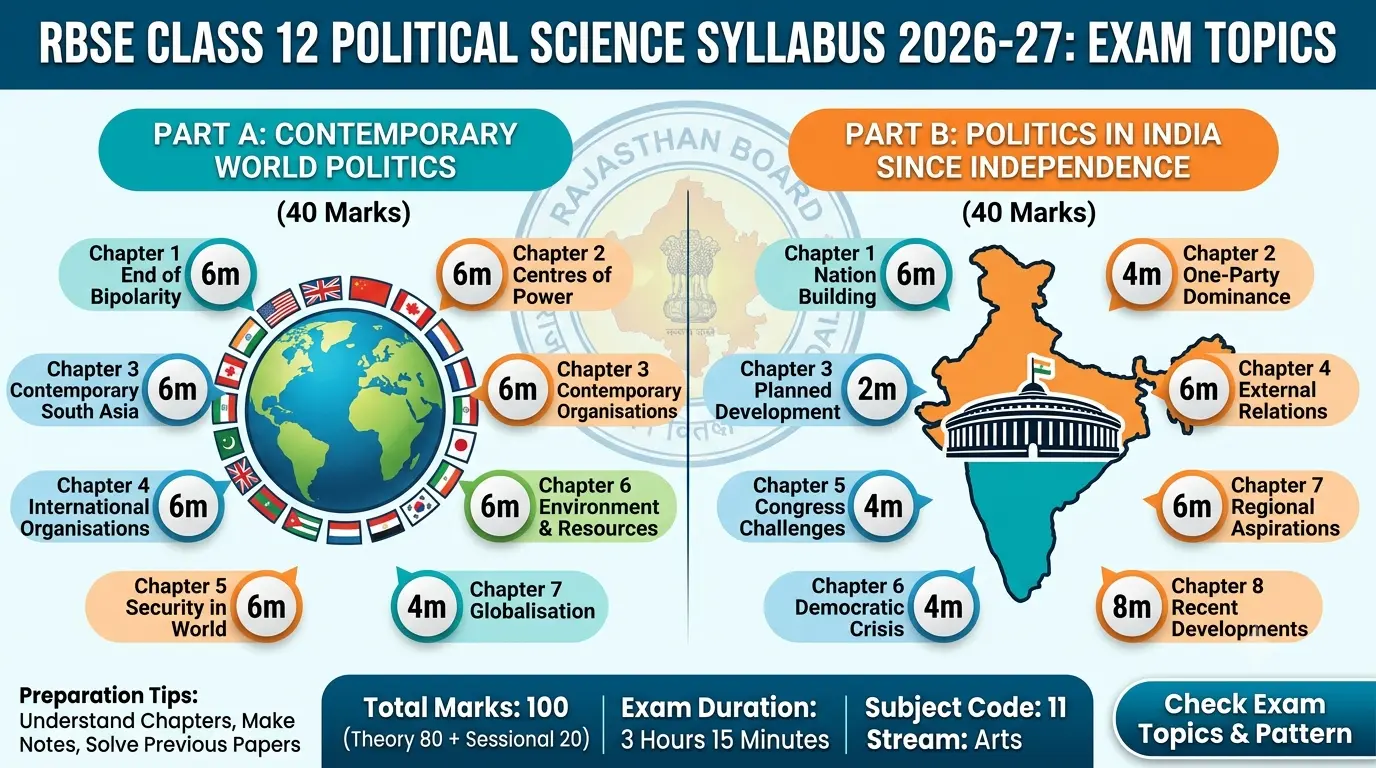
RBSE Class 12 Political Science Syllabus 2026-27: Important Details
Before looking at the chapter-wise topics, check the basic details of the subject.
| Particulars | Details |
|---|---|
| Board | Board of Secondary Education, Rajasthan |
| Examination | RBSE Class 12 Board Exam 2027 |
| Academic Session | 2026-27 |
| Class | 12th |
| Subject | Political Science |
| Subject Code | 11 |
| Stream | Arts |
| Theory Marks | 80 |
| Sessional/Internal Assessment | 20 |
| Total Marks | 100 |
| Exam Duration | 3 Hours 15 Minutes |
| Syllabus Format |
The subject code for Political Science is 11. You will have to prepare two parts for the theory examination. The written paper carries 80 marks, and the internal or sessional assessment carries 20 marks.RBSE Class 12 Political Science Syllabus 2026-27.
RBSE Class 12 Political Science Marks Distribution 2026-27
The Political Science syllabus has two main parts. The first part deals with politics around the world. The second part covers important political events and developments in India after Independence.
Each part carries 40 marks. Therefore, you should give equal attention to both parts while preparing for the examination.
| Part | Subject | Marks |
|---|---|---|
| Part A | Contemporary World Politics | 40 |
| Part B | Politics in India Since Independence | 40 |
| Total | Theory Examination | 80 |
The table shows that both parts have equal weightage. However, the marks given to individual chapters are different. You should check the chapter-wise marks before deciding how much time to spend on each topic. RBSE Class 12 Political Science Syllabus 2026-27.
RBSE Class 12 Political Science Chapter-Wise Syllabus 2026-27
The complete syllabus is divided into two parts. Part A has seven chapters, while Part B has eight chapters.
You should study every chapter carefully. Some chapters carry 6 or 8 marks, while others carry fewer marks. The following sections explain all the chapters and their topics. RBSE Class 12 Political Science Syllabus 2026-27.
Part A: Contemporary World Politics
- This part covers important changes in world politics. You will study the end of the Soviet Union, the rise of powerful countries, international organisations, security, environmental issues and globalisation.
- There are seven chapters in this part.
Chapter 1: The End of Bipolarity (6 Marks)
This chapter explains the end of the Cold War period and the breakup of the Soviet Union. You will learn how world politics changed after the Soviet Union ended.
The important topics are:
- The Soviet System
- Gorbachev and the Soviet Union’s disintegration
- Disintegration of the Soviet Union
- Consequences of the disintegration
- Shock Therapy in post-communist regimes
- Consequences of Shock Therapy
- Tensions and Conflicts
- India and post-communist countries
- India and the USSR
Chapter 2: Contemporary Centres of Power (6 Marks)
This chapter explains how different countries and groups have become powerful in world politics. It covers the European Union, ASEAN, China, Japan and South Korea.
The important topics are:
- European Union
- Association of South East Asian Nations (ASEAN)
- Rise of the Chinese Economy
- India-China Relations
- Japan
- South Korea
Chapter 3: Contemporary South Asia (6 Marks)
In this chapter, you will learn about the political conditions of South Asian countries. It also explains the relationship between India and its neighbouring countries.
The important topics are:
- South Asia
- Military and Democracy in Pakistan
- Democracy in Bangladesh
- Monarchy and Democracy in Nepal
- Ethnic Conflict and Democracy in Sri Lanka
- India-Pakistan Conflicts
- India and its other neighbouring countries
- Peace and Cooperation
Chapter 4: International Organisations (6 Marks)
This chapter explains why international organisations are needed and how they help countries work together. You will also learn about the United Nations and other important organisations.
The important topics are:
- Importance of International Organisations
- Evolution of the United Nations (UNO)
- Reform of the UNO after the Cold War
- Reform of UNO Structures and Processes
- Jurisdiction of the UNO
- India and UNO Reforms
- The UNO in a Unipolar World
- International Monetary Fund (IMF)
- World Bank
- World Trade Organization (WTO)
- International Atomic Energy Agency (IAEA)
- Non-Governmental Organisations (NGOs)
- Amnesty International
- Human Rights Watch
Chapter 5: Security in the Contemporary World (6 Marks)
This chapter explains the meaning of security and the different dangers faced by countries. You will learn about both traditional and modern security problems.
The important topics are:
- Meaning of Security
- Traditional Notions of Security: External
- Traditional Notions of Security: Internal
- Traditional Security and Cooperation
- Non-Traditional Notions of Security
- Cooperative Security
- New Sources of Threats
- Human Rights
- India’s Security Strategy
Chapter 6: Environment and Natural Resources (6 Marks)
This chapter deals with environmental problems and the use of natural resources. It also explains how countries can work together to protect the environment.
The important topics are:
- Environmental Concerns in Global Politics
- Protection of Global Commons
- Common but Differentiated Responsibilities
- Common Property
- India’s Stand on Environmental Issues
- Environmental Movements: One or Many
- Resource Geopolitics
- Indigenous Peoples and Their Rights
- Sacred Groves in India
- Who Owns Antarctica?
- Forests and Uninhabited Areas
Chapter 7: Globalisation (4 Marks)
This chapter explains globalisation and how it connects different countries. You will learn about its causes, effects and impact on India.
The important topics are:
- Concept of Globalisation
- Causes of Globalisation
- Consequences of Globalisation
- Political Consequences
- Economic Consequences
- Cultural Consequences
- India and Globalisation
- Resistance to Globalisation
- India and Resistance to Globalisation
Part A: Chapter-Wise Marks Distribution
The seven chapters in Contemporary World Politics carry a total of 40 marks. Most chapters carry 6 marks each, while Globalisation carries 4 marks. RBSE Class 12 Political Science Syllabus 2026-27.
| Chapter | Name | Marks |
|---|---|---|
| 1 | The End of Bipolarity | 6 |
| 2 | Contemporary Centres of Power | 6 |
| 3 | Contemporary South Asia | 6 |
| 4 | International Organisations | 6 |
| 5 | Security in the Contemporary World | 6 |
| 6 | Environment and Natural Resources | 6 |
| 7 | Globalisation | 4 |
| Total | 40 |
You should give special attention to the first six chapters because each carries 6 marks. However, do not leave Globalisation, as it also contributes 4 marks to your theory paper.
Part B: Politics in India Since Independence
This part covers the political history of India after Independence. You will learn about the challenges faced by the new nation, the Congress party, economic planning, India’s foreign relations, the Emergency and changes in Indian politics. RBSE Class 12 Political Science Syllabus 2026-27.
There are eight chapters in this part.
Chapter 1: Challenges of Nation Building (6 Marks)
After Independence, India faced many problems. This chapter explains how the country dealt with these problems and worked towards becoming a united nation. RBSE Class 12 Political Science Syllabus 2026-27.
The important topics are:
- Challenges for the New Nation
- Three Challenges
- Partition: Displacement and Rehabilitation
- Process of Partition
- Consequences of Partition
- Mahatma Gandhi’s Sacrifice
- Integration of Princely States
- Hyderabad Princely State
- Manipur Princely State
- Government’s Approach
- Reorganisation of States
- Creation of New States
Chapter 2: Era of One-Party Dominance (4 Marks)
This chapter explains how the Congress party became the most powerful political party in the early years after Independence. You will also learn about the rise of opposition parties in India. RBSE Class 12 Political Science Syllabus 2026-27.
The important topics are:
- Challenge of Building Democracy
- Congress Dominance in the First Three General Elections
- Nature of Congress Dominance
- Emergence of Opposition Parties
- Socialist Party
- Communist Party of India
- Bharatiya Jana Sangh
- Changing Voting Patterns
Chapter 3: Politics of Planned Development (2 Marks)
This chapter explains how India planned its economic development after Independence. You will learn why planning was needed and how the government worked to improve the country’s economy. RBSE Class 12 Political Science Syllabus 2026-27.
The important topics are:
- Political Contestation
- Political Conflicts
- Ideas of Development
- Planning
- Early Initiatives
- First Five-Year Plan
- Rapid Industrialisation
- Decentralised Planning
- Planning Commission
- NITI Aayog
Chapter 4: India’s External Relations (6 Marks)
This chapter covers India’s relationship with other countries after Independence. It explains India’s foreign policy and its efforts to maintain peace with other nations. RBSE Class 12 Political Science Syllabus 2026-27.
The important topics are:
- International Context
- Policy of Non-Alignment
- Jawaharlal Nehru’s Role
- Distance from the Two Camps
- Afro-Asian Unity
- Peace and Conflict with China
- Chinese Invasion of 1962
- Tibet
- Wars and Peace with Pakistan
- Bangladesh War of 1971
- Kargil Confrontation
- India’s Nuclear Policy
- India’s Nuclear Programme
- Changing Equations of World Politics
Chapter 5: Challenges to and Restoration of the Congress System (4 Marks)
This chapter explains the political problems faced by the Congress party during the 1960s and 1970s. You will learn about the change in leadership, elections and the split within the Congress party. RBSE Class 12 Political Science Syllabus 2026-27.
The important topics are:
- Challenge of Political Succession
- Fourth General Elections of 1967
- Electoral Verdict
- Non-Congressism
- Coalitions
- Defection
- Split in the Congress
- Indira Gandhi versus the Syndicate
- Presidential Election of 1969
- The 1971 Election and Restoration of Congress
- Abolition of Privy Purse
Chapter 6: The Crisis of the Democratic Order (4 Marks)
This chapter explains the Emergency period in India. You will learn why the Emergency was declared and how it affected Indian democracy. RBSE Class 12 Political Science Syllabus 2026-27.
The important topics are:
- Background to the Emergency
- Gujarat and Bihar Movements
- Conflict with the Judiciary
- Declaration of Emergency
- Lessons of the Emergency
- Politics After the Emergency
- Lok Sabha Election of 1977
- Janata Government
Chapter 7: Regional Aspirations (6 Marks)
India has many different regions, languages and cultures. This chapter explains how different regions demanded their rights and greater freedom. It also covers the steps taken to maintain national unity. RBSE Class 12 Political Science Syllabus 2026-27.
The important topics are:
- Region and Nation
- Indian Approach
- Areas of Tension
- Jammu and Kashmir
- Roots of the Problem
- External and Internal Disputes
- Punjab
- Political Context
- Cycle of Violence
- Road to Peace
- North-East Demands for Autonomy
- Secessionist Movements
- Movements Against Outsiders
- Accommodation and National Integration
- Sikkim’s Merger
- Goa’s Liberation
- Dravidian Movement
Chapter 8: Recent Developments in Indian Politics (8 Marks)
This chapter explains major changes in Indian politics during the 1990s. You will learn about coalition governments, the decline of Congress and the rise of other political parties. RBSE Class 12 Political Science Syllabus 2026-27.
The important topics are:
- Concept of the 1990s
- Era of Coalitions
- Decline of Congress
- Alliance Politics
- Political Rise of Other Backward Classes (OBCs)
- Mandal Commission
- Political Fallouts
- Communalism
- Secularism
- Democracy
- Ayodhya Dispute
- Demolition and After
- Emergence of a New Consensus
Part B: Chapter-Wise Marks Distribution
Politics in India Since Independence carries 40 marks in the theory paper. Chapter 8, Recent Developments in Indian Politics, carries the highest weightage of 8 marks. RBSE Class 12 Political Science Syllabus 2026-27.
| Chapter | Name | Marks |
|---|---|---|
| 1 | Challenges of Nation Building | 6 |
| 2 | Era of One-Party Dominance | 4 |
| 3 | Politics of Planned Development | 2 |
| 4 | India’s External Relations | 6 |
| 5 | Challenges to and Restoration of the Congress System | 4 |
| 6 | The Crisis of the Democratic Order | 4 |
| 7 | Regional Aspirations | 6 |
| 8 | Recent Developments in Indian Politics | 8 |
| Total | 40 |
You should give extra attention to Recent Developments in Indian Politics because it carries 8 marks. Also, prepare the chapters on Nation Building, External Relations and Regional Aspirations properly, as each carries 6 marks. RBSE Class 12 Political Science Syllabus 2026-27.
RBSE Class 12 Political Science Exam Pattern 2026-27
The RBSE Class 12 Political Science examination carries 100 marks in total. Out of these, 80 marks are for the written examination, and 20 marks are for sessional or internal assessment. RBSE Class 12 Political Science Syllabus 2026-27.
You will get 3 hours and 15 minutes to complete the written examination, as mentioned in the available RBSE examination scheme.
The marks are divided as follows:
| Examination Component | Marks |
|---|---|
| Theory Examination | 80 |
| Sessional/Internal Assessment | 20 |
| Total | 100 |
You should prepare for both the written examination and internal assessment. Do not focus only on the theory paper. RBSE Class 12 Political Science Syllabus 2026-27.
RBSE Class 12 Political Science Question Paper Pattern
The RBSE Class 12 Political Science question paper includes different types of questions. These questions check your understanding of political events, important concepts and historical developments. RBSE Class 12 Political Science Syllabus 2026-27.
You should practise the following types of questions:
- Multiple-Choice Questions (MCQs)
- Very Short-Answer Questions
- Short-Answer Questions
- Long-Answer Questions
- Descriptive Questions
The question paper may also include internal choices in some questions. This means you may get two questions and have to answer only one of them.
The exact number of questions and marks for each question type should be checked in the latest RBSE model paper. The Board’s official website provides model question papers to help students understand the examination format. RBSE Class 12 Political Science Syllabus 2026-27.
How to Download RBSE Class 12 Political Science Syllabus 2026-27 PDF
You can download the syllabus from the official Rajasthan Board website. Follow these steps:
- Visit the official website of RBSE at rajeduboard.rajasthan.gov.in.
- Open the syllabus or examination-related section.
- Look for the Class 12 syllabus for the 2026-27 academic session.
- Find Political Science in the subject list.
- Click on the download link.
- Open the PDF and check all the chapters and topics.
- Download and save the file on your mobile phone or computer.
RBSE Class 12 Political Science Syllabus
Official Rajasthan Board website
Visit Official RBSE Website. RBSE Class 12 Political Science Syllabus 2026-27.
Preparation Tips for RBSE Class 12 Political Science Exam 2027
If you want to score good marks in Political Science, you should follow a proper study plan. Do not wait until the last few weeks to complete the syllabus. RBSE Class 12 Political Science Syllabus 2026-27.
Here are some useful tips to help you prepare for the Rajasthan Board examination.
1. Understand Every Chapter
- Start by reading all the chapters in your textbook. Try to understand the meaning of each topic instead of memorising every sentence.
- Give special attention to political events, important decisions, international organisations and India’s relationship with other countries.
2. Make Short Notes for Every Chapter
- Prepare short notes while studying. Write down important dates, names, events and political terms.
- These notes will help you revise the chapters quickly before the examination.
3. Give More Time to Important Chapters
- Check the chapter-wise marks distribution before making your study timetable.
- Recent Developments in Indian Politics carries 8 marks. Several other chapters carry 6 marks each. You should prepare these chapters properly.
- However, do not skip chapters with fewer marks. Every chapter is part of your prescribed syllabus.
4. Practise Long-Answer Questions
- Political Science includes questions that require detailed answers.
- Practise writing answers in simple language. Divide long answers into small paragraphs. Use suitable examples wherever necessary.
- Also, make sure your answers cover all the important points asked in the question. RBSE Class 12 Political Science Syllabus 2026-27.
5. Revise Important Political Events
Give special attention to these topics:
- Cold War and the end of bipolarity
- Disintegration of the Soviet Union
- Rise of China
- United Nations and other international organisations
- India’s foreign policy
- Partition of India
- Emergency in India
- Regional movements
- Mandal Commission
- Coalition governments
These topics are part of the prescribed chapters and should be included in your revision plan.
6. Solve Previous Year Question Papers
- Previous year question papers help you understand how questions are asked in the RBSE examination.
- Try to solve the papers without checking the answers. After completing them, check your mistakes and revise the related chapters.
7. Practise the Latest Model Paper
- Download the latest RBSE Class 12 Political Science model paper from the official website.
- Solve the paper within the given examination time. This will help you improve your writing speed and manage your time properly.
8. Revise Both Parts Regularly
- Do not prepare only Contemporary World Politics or Politics in India Since Independence.
- Both parts carry 40 marks each. So, give equal attention to both sections.
- Make a weekly revision plan and try to complete the entire syllabus before the final examination. RBSE Class 12 Political Science Syllabus 2026-27.
Important Things Students Should Remember
Before starting your preparation, remember these points:
- Political Science is subject code 11.
- The subject is part of the Arts stream.
- The theory examination carries 80 marks.
- Internal or sessional assessment carries 20 marks.
- The total marks are 100.
- The examination duration is 3 hours and 15 minutes.
- Part A carries 40 marks.
- Part B also carries 40 marks.
- Part A has seven chapters.
- Part B has eight chapters.
- Recent Developments in Indian Politics carries the highest chapter-wise weightage of 8 marks.
- You should practise MCQs, short-answer and long-answer questions.
- Always check the latest official syllabus and model paper before the examination.
Also Check Out:- DSSSB MTS Syllabus and Exam Pattern 2026: Subject-Wise Topics
FAQs
1. Has RBSE released the Class 12 Political Science Syllabus 2026-27?
- Students should check the official Rajasthan Board website for the latest 2026-27 syllabus PDF. The chapter-wise structure and marks distribution given in this article follow the syllabus details provided above. The previously available official RBSE syllabus document is for 2025-26, so students should confirm any changes in the new session’s PDF. RBSE Class 12 Political Science Syllabus 2026-27.
2. How many parts are there in the RBSE Class 12 Political Science syllabus?
- There are two main parts. Part A is Contemporary World Politics, which carries 40 marks. Part B is Politics in India Since Independence, which also carries 40 marks. RBSE Class 12 Political Science Syllabus 2026-27.
3. How many marks does the RBSE Class 12 Political Science theory paper carry?
- The theory paper carries 80 marks. The remaining 20 marks are for sessional or internal assessment. Therefore, the total marks are 100. RBSE Class 12 Political Science Syllabus 2026-27.
4. What is the exam duration for RBSE Class 12 Political Science 2027?
- The available RBSE examination scheme mentions 3 hours and 15 minutes for the Political Science examination. RBSE Class 12 Political Science Syllabus 2026-27.
5. Which chapter carries the highest marks in RBSE Class 12 Political Science?
- Recent Developments in Indian Politics carries the highest chapter-wise weightage of 8 marks in the chapter-wise distribution given in this syllabus. RBSE Class 12 Political Science Syllabus 2026-27.
