
The National Commission for Allied and Healthcare Professions (NCAHP) has proposed new rules for allied and healthcare professionals through the NCAHP Draft 2026. Under these proposed rules, professionals who do not have qualifications recognised by the commission may have to complete a special bridge course and pass a qualifying examination to continue their professional work.
Table of ContentsQuickly navigate to the information you need
This proposal may affect many working professionals who have certificates, diplomas and even some bachelor’s or master’s degrees. Their existing qualifications may not meet the new educational standards set by NCAHP. However, professionals whose qualifications already meet the commission’s requirements will not have to complete a bridge course. They can directly apply for professional registration.
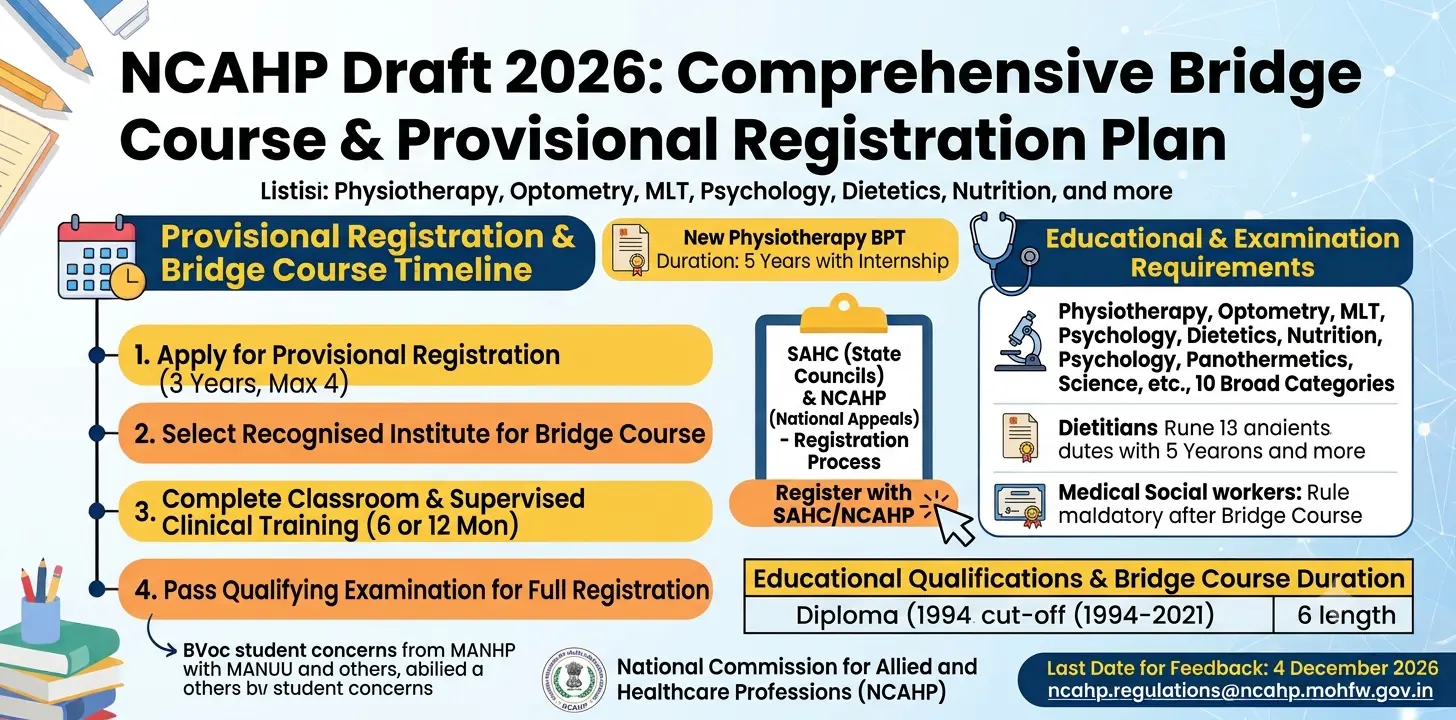
Under the proposed system, eligible working professionals can first apply for provisional registration with their respective State Allied and Healthcare Councils (SAHC). They will then get time to complete the required bridge course and pass the qualifying examination. The proposed time limit for obtaining full registration is three years.
The NCAHP Draft 2026 is called the Provisional Registration of Allied and Healthcare Professionals Regulations, 2026. The commission has placed this draft in the public domain to collect suggestions and objections before making the final rules. It covers 10 broad allied health science categories, including physiotherapy, optometry, medical laboratory technology (MLT), psychology, and dietetics and nutrition.
These proposed rules mainly aim to help professionals who received their training before NCAHP was established in 2021. The commission wants to bring their qualifications in line with the newer education standards. In this article, you will learn about the proposed bridge courses, registration process, eligibility conditions, qualifying examination and other important details of the NCAHP Draft 2026.
NCAHP Draft 2026: Main Highlights
Here are the main points of the proposed NCAHP rules.
| Particulars | Details |
|---|---|
| Regulatory Body | National Commission for Allied and Healthcare Professions (NCAHP) |
| Draft Name | Provisional Registration of Allied and Healthcare Professionals Regulations, 2026 |
| Main Purpose | Provisional registration and bridge courses for eligible working professionals |
| Professional Categories | 10 broad categories |
| Examples of Professions | Physiotherapy, Optometry, MLT, Psychology, Dietetics and Nutrition |
| Registration Type | Provisional Registration |
| Registration Authority | State Allied and Healthcare Councils (SAHC) or NCAHP, where applicable |
| Proposed Provisional Registration Period | 3 Years |
| Possible Extension | 1 Additional Year |
| Bridge Course Duration | 6 Months or 1 Year, depending on the profession and qualification |
| Final Registration Requirement | Required bridge course and qualifying examination |
| Regulatory Law | National Commission for Allied and Healthcare Professions Act, 2021 |
The table gives you an overview of the NCAHP Draft 2026. Remember that these are proposed rules, not a final notification of the provisional registration process. The final requirements will depend on the regulations approved and notified by the commission.
Why Has NCAHP Proposed New Rules for Allied Health Professionals?
The allied and healthcare sector in India has had different education systems and training standards. Many professionals received their training through certificates, diplomas and degree courses before NCAHP was established in 2021.
As a result, the qualifications and course structures were not the same everywhere. Some professionals completed their education under older systems that do not match the new standards introduced by the commission.
The National Commission for Allied and Healthcare Professions was established under the NCAHP Act, 2021. It works to improve the quality of education, training and professional standards in the allied healthcare sector.
The commission has been preparing common course structures, education standards and registration rules for different allied health professions. It has also introduced rules for creating state and national registers for professionals working in 57 allied fields.
The NCAHP Draft 2026 is another step towards bringing older qualifications into the new system. It provides a possible way for eligible working professionals to continue their work while completing the additional education and examination requirements.
The proposed rules are not meant for everyone. If your qualification already meets the NCAHP standards, you can apply for regular registration directly without going through this provisional registration arrangement.
NCAHP Draft 2026: Which Allied Health Courses Are Included?
The proposed NCAHP Draft 2026 covers professionals working in 10 broad allied and healthcare categories. These include several important healthcare fields.
Some of the professions mentioned in the draft are:
- Physiotherapy
- Optometry
- Medical Laboratory Technology (MLT)
- Psychology
- Dietetics and Nutrition
- Community Care
- Behavioural Health Sciences
The draft also covers other allied and healthcare professional fields under its 10 broad categories.
The rules will depend on your profession and existing educational qualification. Therefore, the bridge course requirement will not be the same for every professional. NCAHP has proposed different education and experience requirements for different fields. Careers360
NCAHP Registration 2026: Educational Qualification and Bridge Course Rules
One of the main parts of the NCAHP Draft 2026 is the educational qualification requirement. The commission has proposed different bridge courses based on your existing qualification and work experience.
The bridge courses may last for six months or one year. They will also include supervised clinical training wherever required.
This means you may have to complete classroom learning as well as practical training under the supervision of experienced professionals.
1. Rules for Physiotherapy Professionals
Physiotherapy professionals with older qualifications may have to complete a bridge course to meet the new NCAHP education standards.
The draft mentions two separate one-year bridge courses for the following candidates:
- Physiotherapists holding a two-year or three-year diploma.
- Physiotherapists holding a Bachelor of Vocation (BVoc) degree.
However, there are certain conditions for accepting these qualifications.
For diploma holders, only diplomas recognised by the respective state government will be considered. The relevant admission batches must fall between 1994 and 2021.
For BVoc degree holders, the course must follow the University Grants Commission (UGC) regulations. The year 2021 has been set as the cut-off year in the proposed rules.
2. New Physiotherapy Qualification Under NCAHP
NCAHP has introduced new education standards for physiotherapy courses. Under these standards, the recognised qualification for becoming a physiotherapy professional is the Bachelor of Physiotherapy (BPT) degree.
The commission has also changed the course duration.
Earlier, the BPT programme lasted four and a half years. Under the revised course structure, it will take five years to complete. This includes six months of compulsory internship.
The commission also plans to make appearing for the National Eligibility-cum-Entrance Test (NEET) compulsory for admission to the BPT course.
These changes aim to improve physiotherapy education and make training standards more uniform across India. Careers360
3. Rules for Dieticians and Medical Social Workers
The proposed rules may also affect professionals working as dieticians and medical social workers.
Even if you hold a postgraduate (PG) diploma or degree in these fields, you may still have to complete a bridge course if your qualification does not meet the new NCAHP standards.
This means having a higher qualification does not automatically make you eligible for direct registration. Your course must also meet the recognition requirements of the commission.
4. Experience Requirements for Other Professionals
Some professionals working in Community Care, Behavioural Health Sciences and other allied healthcare fields will also have to meet minimum work experience requirements.
The required experience may range from one year to five years.
The exact experience requirement will depend on your specialisation and educational qualification. Therefore, you should check the rules for your particular profession before applying for provisional registration.
NCAHP Qualifying Exam 2026: Will Professionals Have to Pass an Examination?
Yes. Under the proposed NCAHP Draft 2026, eligible professionals will generally have to pass a qualifying examination after completing their bridge course.
The purpose of this examination is to check whether you have gained the required knowledge and skills to meet the new professional standards.
However, the draft also provides some flexibility.
In certain cases, the examination conducted by the institute offering the bridge course may itself be treated as the qualifying examination.
This means you may not have to appear for a separate examination if the institute’s examination is accepted as the required qualifying test under the final rules.
The exact examination process will depend on the final regulations issued by NCAHP. Careers360
NCAHP Provisional Registration: How Will Working Professionals Get Registered?
The NCAHP Draft 2026 proposes a provisional registration system for working professionals who do not have the recognised educational qualifications required for regular registration.
Under this system, eligible professionals can apply to their respective State Allied and Healthcare Councils (SAHC).
However, there is another option for professionals living in states where a functional State Allied and Healthcare Council is not available. They can apply directly to NCAHP.
Here is how the proposed process will work:
- First, you will have to apply for provisional registration with your respective State Allied and Healthcare Council.
- If your state does not have a functioning council, you can apply directly to NCAHP.
- The concerned authority will check your educational qualification and other eligibility conditions.
- If your application is accepted, you will receive a provisional registration certificate.
- After getting provisional registration, you will have to complete the required bridge course.
- You will also have to pass the qualifying examination to obtain full registration.
What If the State Council Rejects Your Application?
The draft also provides an option for candidates whose provisional registration applications are rejected by their state councils.
If your application is rejected, you can appeal to the National Commission for Allied and Healthcare Professions (NCAHP).
The commission will then consider your appeal according to the proposed rules.
How Long Will Provisional Registration Remain Valid?
Under the proposed regulations, the provisional registration certificate will remain valid for three years.
However, the commission may extend this period by another year.
This means you may get a maximum period of four years to complete the required bridge course and examination, subject to the final rules and approval.
One important point is that you will not be allowed to continue your professional practice after your provisional registration certificate expires.
Therefore, you should complete all the required steps within the permitted period and obtain full registration. Careers360
Where Will the NCAHP Bridge Courses Be Conducted?
NCAHP has proposed that existing recognised allied and healthcare education institutes will conduct the bridge courses.
This means working professionals may be able to complete their additional training at recognised colleges and institutes that already offer allied healthcare education.
The commission has also proposed some rules for these institutes.
1. Existing Recognised Institutes Will Conduct the Courses
Only existing recognised allied and healthcare education institutes will be allowed to run the proposed bridge courses.
These institutes will provide the required academic learning and supervised clinical training according to the course requirements.
2. Colleges Can Offer Additional Seats
The recognised institutes will be allowed to offer the same number of seats for bridge courses as they have for their regular courses.
However, colleges can also request additional seats for bridge programmes.
This will give institutes the option to provide training to more working professionals if they receive approval for extra seats.
3. Admission Will Follow a First-Come, First-Served System
NCAHP has proposed a transparent admission process for bridge courses.
Candidates will be admitted on a first-come, first-served basis.
This means you should apply on time once the admission process begins. However, you must also meet the eligibility conditions set for your profession.
4. What Will Be the Bridge Course Fees?
The draft says that professionals will have to pay a fee that is approximately proportional to the fee charged by the institute for its regular courses.
In simple words, the bridge course fee will be linked to the fees charged for the institute’s regular programmes.
However, the draft does not mention one fixed fee for all bridge courses. The actual amount may differ from one institute to another. Careers360
Why Are BVoc and MVoc Students Worried About NCAHP Draft 2026?
The proposed NCAHP rules have raised concerns among some students who are pursuing allied healthcare courses that may not be recognised under the commission’s new education standards.
One such example is Maulana Azad National Urdu University (MANUU), a central university located in Hyderabad.
Around 600 BVoc and MVoc students from Medical Imaging Technology (MIT) and Medical Laboratory Technology (MLT) have been protesting against the recognition of their courses under the new NCAHP system.
These students are concerned about the additional training and registration requirements.
One of the students, Md Minhaj, is a fourth-year BVoc Medical Imaging Technology student at MANUU.
He questioned why students who completed their courses through regular classroom education should have to apply for provisional registration.
He also suggested that if NCAHP does not accept the BVoc course name, the degree could simply be renamed as BSc.
Another concern raised by him is about the qualifications listed in the proposed rules. According to him, the draft includes three-year BVoc degrees among the minimum qualifications but does not clearly mention four-year BVoc or MVoc degrees.
This has created uncertainty among students about their future education and professional registration.
The NCAHP chairperson, Yagna Shukla, did not comment on the proposed rules because they were still under public consultation when the report was published. Careers360
NCAHP Draft 2026: Public Feedback and Important Dates
The National Commission for Allied and Healthcare Professions released a public notice on 3 November 2026 regarding the proposed provisional registration regulations.
The draft has been made available for public feedback. Professionals, students, educational institutions and other interested people can send their suggestions, comments and objections to the commission.
Here are the important details:
| Particulars | Details |
|---|---|
| Draft Name | Provisional Registration of Allied and Healthcare Professionals Regulations, 2026 |
| Public Notice Date | 3 November 2026 |
| Notice Number | No. AHS/60/2026-NCAHP |
| Issuing Authority | Umesh Balonda, Secretary, NCAHP |
| Legal Basis | NCAHP Act, 2021 |
| Last Date for Suggestions | 4 December 2026 |
| Email for Suggestions | [email protected] |
If you want to submit any suggestion or objection, you can send it to the above email address by 4 December 2026.
You should mention the relevant rule or section in your email. Also, explain what change you want and why you think that change is necessary.
Read the complete draft and its related documents before sending your suggestions.
Has NCAHP Started Provisional Registration?
No. The publication of the draft does not mean that the provisional registration process has started.
At present, NCAHP is asking for public comments and suggestions on the proposed rules. The public notice does not announce the opening of an application portal.
It also does not provide a registration application form, application fee or confirmed application starting date.
Therefore, you should not treat the proposed rules as final. Wait for the commission to publish the final regulations and official registration instructions. The Pharmacist
What Will Happen After the Public Consultation?
After receiving suggestions and objections, NCAHP may review the feedback and make changes to the proposed regulations.
The expected process is:
- NCAHP publishes the draft regulations for public feedback.
- Interested professionals, students and organisations submit their suggestions by 4 December 2026.
- The commission reviews the received comments and objections.
- NCAHP may make changes to the proposed rules.
- The final regulations will be issued after the consultation process.
The commission has not announced any confirmed date for publishing the final regulations.
So, you should keep checking the official website for further updates. The Pharmacist
Important Links for NCAHP Draft 2026
You can use the following links to check the official information and proposed regulations.
| Important Links | Direct Link |
|---|---|
| NCAHP Official Website | Visit Website |
| NCAHP Draft Regulations | Check Draft Regulations |
| Public Feedback Email | [email protected] |
| Ministry of Health and Family Welfare Update | Read PIB Notice |
You should always check the official NCAHP website before making any decision about your education, professional registration or bridge course.
My Final Suggestion
The NCAHP Draft 2026 is an important development for allied and healthcare professionals across India. The proposed rules may affect many working professionals who completed their education before the commission introduced its new qualification standards.
If your qualification does not meet the new requirements, you may have to complete a bridge course and pass a qualifying examination to obtain full professional registration. However, professionals who already meet the recognised qualification standards can apply for regular registration directly.
If you are a BVoc, MVoc, diploma or degree holder working in the allied healthcare sector, you should carefully check how these proposed rules may affect your profession. Also, remember that these are still draft regulations and not final rules. Wait for the official notification before making any decision about your career or professional registration.
Also Check Out:- Calcutta University MBA Admission 2027 Notification Out, Apply Offline
FAQs
Q1. What is NCAHP Draft 2026?
NCAHP Draft 2026 is a proposed set of rules for the provisional registration of allied and healthcare professionals who do not have qualifications recognised by the commission. It may require eligible professionals to complete a bridge course and pass a qualifying examination.
Q2. Who will need to complete the NCAHP bridge course?
Working professionals whose existing educational qualifications do not meet the new NCAHP standards may have to complete a bridge course. The requirement will depend on their profession, qualification and work experience.
Q3. How many allied health categories are included in the NCAHP Draft 2026?
The draft covers 10 broad allied and healthcare categories. These include physiotherapy, optometry, medical laboratory technology, psychology, dietetics and nutrition.
Q4. Will professionals with bachelor’s and master’s degrees also need a bridge course?
Yes, in some cases. Even professionals with bachelor’s and master’s degrees may have to complete a bridge course if their qualifications are not recognised under the new NCAHP standards.
Q5. What is the duration of the NCAHP bridge course?
The proposed bridge courses may last for six months or one year. The duration will depend on your existing qualification, profession and experience.
Q6. Will physiotherapy diploma holders need a bridge course?
According to the draft, eligible physiotherapy professionals with recognised two-year or three-year diplomas may have to complete a one-year bridge course. The diploma must be recognised by the state government, and the relevant admission batches must fall between 1994 and 2021.
Q7. Can BVoc students apply for NCAHP registration?
The draft includes certain BVoc qualifications among the minimum qualifications for provisional registration. However, the BVoc course must meet the UGC requirements, with 2021 as the cut-off year mentioned in the proposal. The draft specifically mentions three-year BVoc qualifications in the reported provisions.
Q8. Is there any qualifying examination after the bridge course?
Yes, the proposed rules generally require professionals to pass a qualifying examination after completing the bridge course. In some cases, the examination conducted by the institute may be treated as the qualifying test.
Q9. How long will provisional registration remain valid?
The proposed provisional registration certificate will remain valid for three years. It may be extended for another year under the proposed rules.
Q10. Where can professionals apply for provisional registration?
You can apply through your respective State Allied and Healthcare Council (SAHC). If your state does not have a functioning council, you can apply directly to NCAHP under the proposed system.
Q11. What can you do if the State Council rejects your application?
If your application is rejected by the State Allied and Healthcare Council, you can appeal to the National Commission for Allied and Healthcare Professions (NCAHP).
Q12. Where will the NCAHP bridge courses be conducted?
The proposed rules allow existing recognised allied and healthcare education institutes to conduct bridge courses.
Q13. How will candidates get admission to bridge courses?
The proposed admission process will be transparent and based on a first-come, first-served system. Institutes may also request additional seats for these courses.
Q14. What will be the fee for the NCAHP bridge course?
The course fee will be approximately proportional to the fees charged by the institute for its regular programmes. The draft does not specify one fixed fee for all institutes.
Q15. What is the last date to submit suggestions on NCAHP Draft 2026?
The last date to submit suggestions, comments and objections is 4 December 2026.
Q16. Has NCAHP started accepting provisional registration applications?
No. The commission has currently invited public feedback on the proposed regulations. The public notice does not confirm that registration applications have started.
