
Do you enjoy working with numbers, computers and solving problems? Then becoming a data analyst may be a good career choice for you. A data analyst studies information and helps companies make better decisions.
Table of ContentsQuickly navigate to the information you need
You do not always need a computer science degree to enter this field. You need the right skills, regular practice and some good projects to show your work.
This guide explains How to Become a Data Analyst step by step. You will learn which skills to study, which tools to use, how to build a portfolio, where to find jobs and how much you may earn.
If you want to know How to Become a Data Analyst in India, this guide will help you understand the learning path from the beginning.
1. First, Understand What a Data Analyst Does
A data analyst works with information. This information is called data.
For example, a shopping company may have thousands of sales records. It may want to know:
- Which product sells the most?
- Which month brings the highest sales?
- Which city has more customers?
- Why are sales going down?
- Which products should the company promote?
A data analyst studies the records and finds answers.
The main work includes:
- Collecting data from files, websites or databases.
- Checking the data for mistakes.
- Removing repeated or incorrect records.
- Studying the data to find useful facts.
- Making charts, reports and dashboards.
- Explaining the results to other people.
The main aim is to turn large amounts of information into useful answers. Microsoft also explains that data analysts prepare, clean, change and study data before making reports and dashboards. Microsoft Learn+1
When you learn How to Become a Data Analyst, you should first understand this work. You do not need to learn every tool on your first day.
2. Check Whether This Career Is Right for You
You do not have to be a maths expert to start learning data analysis. But you should be comfortable with basic numbers and willing to practise.
This career may suit you if:
- You enjoy solving problems.
- You like working with numbers.
- You are curious about why things happen.
- You enjoy using computers.
- You can check small details carefully.
- You like finding patterns.
- You can explain your ideas clearly.
You should also be ready to learn new tools. Data analysts often work with new types of data and software.
If you are a beginner, do not worry. You can learn one skill at a time. That is the easiest way to understand How to Become a Data Analyst.
3. Learn the Basic Skills First
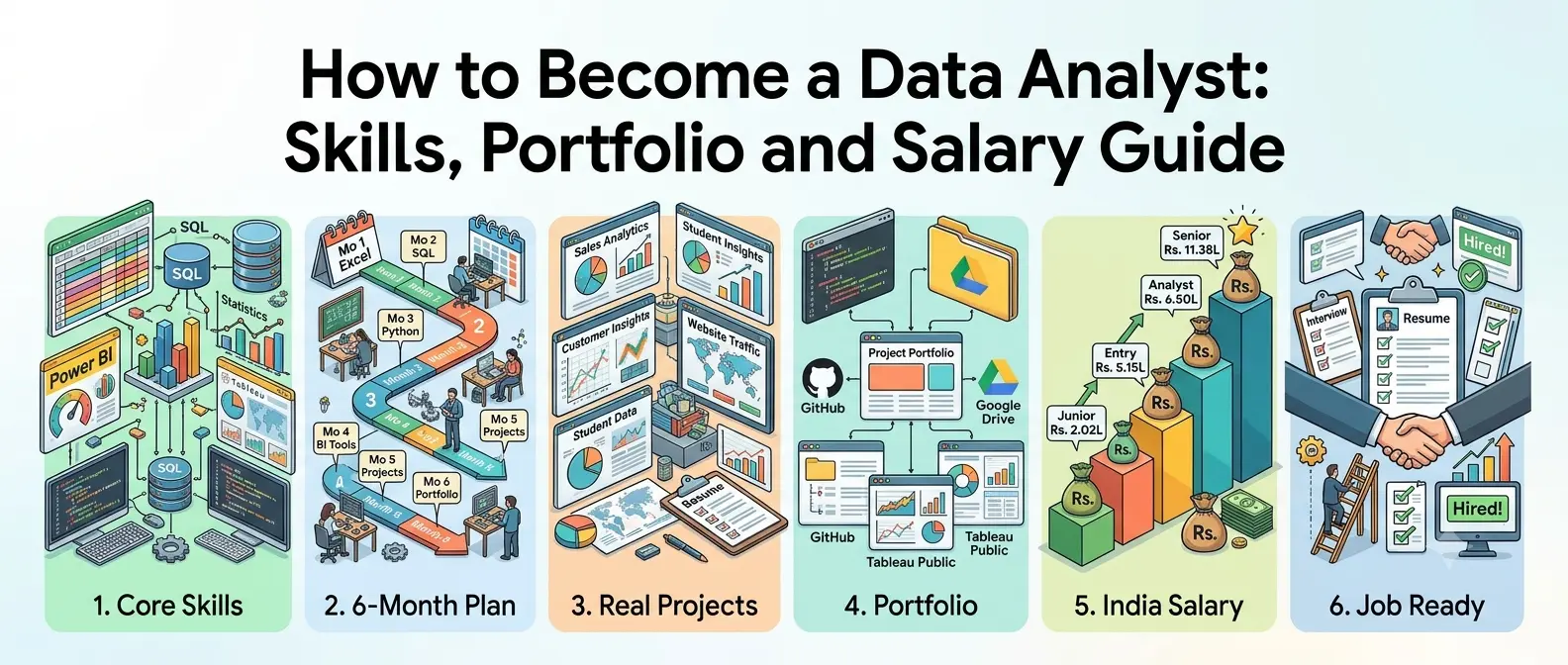
You need a few important skills to start working as a data analyst. Learn them one by one.
Excel
Start with Microsoft Excel or Google Sheets.
These tools help you arrange information in rows and columns. You can also use them to calculate totals, find values and make charts. How to Become a Data Analyst.
Learn these topics:
- Rows, columns and cells.
- Basic formulas.
- SUM, AVERAGE and COUNT.
- IF and COUNTIF.
- VLOOKUP or XLOOKUP.
- Sorting and filtering.
- Pivot Tables.
- Charts.
- Removing duplicate records.
- Cleaning data.
For example, you can use Excel to study the monthly sales of a shop.
Excel is a good first step when learning How to Become a Data Analyst because many companies use spreadsheets.
SQL
SQL means Structured Query Language. It is used to work with databases.
A database stores large amounts of information. SQL helps you find the information you need.
Learn these basic SQL commands:
- SELECT
- FROM
- WHERE
- ORDER BY
- GROUP BY
- JOIN
- COUNT
- SUM
- AVG
For example, a company may have one million customer records. You can use SQL to find customers from a particular city or check sales for a certain month.
You do not need to learn every advanced command at the beginning. First, understand how to find, filter and group data. How to Become a Data Analyst.
Basic Statistics
Statistics helps you understand numbers and compare results.
You should learn:
- Mean or average.
- Median.
- Mode.
- Percentage.
- Minimum and maximum.
- Range.
- Basic probability.
- Charts and graphs.
- Correlation.
For example, you can calculate the average monthly sales of a shop. You can also compare sales from two different years.
You do not need very advanced maths for most beginner data analyst jobs. Start with basic topics and practise them. How to Become a Data Analyst.
Power BI or Tableau
Companies use these tools to create reports and dashboards.
A dashboard shows important information in one place. It may include charts, numbers, filters and graphs.
Learn how to:
- Connect a data file.
- Clean and arrange data.
- Create charts.
- Make tables.
- Add filters.
- Build dashboards.
- Explain what the results show.
You can start with either Power BI or Tableau. You do not need to learn both at the same time.
Microsoft offers free Power BI learning paths. Tableau also provides free training for beginners. How to Become a Data Analyst.
Python
Python is a programming language. It can help you clean, study and manage data.
Start with these topics:
- Variables.
- Data types.
- Lists.
- Conditions.
- Loops.
- Functions.
- Reading files.
- Working with tables.
- Basic charts.
Later, learn the pandas library. It helps you work with data in rows and columns.
Python is useful, but you do not have to master it before making your first project. Learn the basic tools first. How to Become a Data Analyst.
Communication Skills
A data analyst must explain results to other people.
You may find an important change in sales. But your manager may not understand technical words.
You should explain the result in clear language.
For example:
“Sales increased by 15% in March because more customers bought our new product.”
Good communication is an important part of How to Become a Data Analyst. Your work is useful only when other people can understand it.
4. Learn the Tools in the Right Order
Do not try to learn every tool together. It can make you confused.
Follow this order:
| Order | Skill or tool | What you will learn |
|---|---|---|
| 1 | Excel | Formulas, tables and charts |
| 2 | SQL | Finding and grouping data |
| 3 | Statistics | Understanding numbers |
| 4 | Power BI or Tableau | Making reports and dashboards |
| 5 | Python | Cleaning and studying data |
This table gives you a simple learning order. You can move to the next skill after you understand the basics of the previous one.
You can change the order slightly based on your course or job needs. The main point is to build a strong base before learning advanced topics.
This step-by-step method makes How to Become a Data Analyst easier for beginners.
5. Do You Need a Degree to Become a Data Analyst?
A degree can help you, but every company has different rules.
Many employers prefer candidates with a bachelor’s degree in subjects such as:
- Computer Science.
- Mathematics.
- Statistics.
- Economics.
- Business.
- Commerce.
- Engineering.
- Information Technology.
However, some employers also consider people from other subjects if they have the right skills and project experience.
If you do not have a computer science degree, do not give up. Learn Excel, SQL, statistics and a dashboard tool. Build projects and show what you can do.
Always check the education rules in the job advertisement before applying.
Google’s Data Analytics Certificate is designed for beginners and states that no previous experience or degree is required for the course. This does not mean every employer will remove its degree requirement. How to Become a Data Analyst.
6. Build a Portfolio to Show Your Skills
A portfolio is a collection of your work. It helps employers see what you can do.
You should not only watch lessons and collect certificates. You should also practise with real data.
Try to make at least three good projects.
Here are some project ideas.
Project 1: Sales Report
Download a sample sales file. Study the records and find:
- Total sales.
- Best-selling products.
- Monthly sales.
- Sales by city.
- Products with low sales.
Use Excel or Power BI to make a report.
Project 2: Customer Report
Study a sample customer file.
Find:
- Total customers.
- Age groups.
- Customer locations.
- Most common buying habits.
- Repeat customers.
Use charts to show your findings.
Project 3: Student Result Report
Use a sample student result file.
Find:
- Average marks.
- Highest marks.
- Lowest marks.
- Pass percentage.
- Subject-wise results.
Make a dashboard to show the results.
Project 4: Website Traffic Report
Use sample website data to study:
- Total visitors.
- Most visited pages.
- Traffic sources.
- Monthly changes.
- Visitor behaviour.
You can use Excel, SQL, Power BI or Python for these projects.
7. What Should You Include in Your Portfolio?
Do not upload only charts and tables. Explain your work.
For every project, include:
- Project name.
- Main question.
- Data source.
- Tool used.
- Steps you followed.
- Problems you found.
- Charts or dashboard.
- Main results.
- Your final suggestions.
For example, you may find that one product has very low sales. Explain what you found and suggest ways the company could improve sales.
You can keep your work on GitHub, Google Drive or a personal website.
You can also use Tableau Public to share public data charts and dashboards. Remember that work published there can be seen by other people, so never upload private company or customer data.
A good portfolio is one of the most useful steps in How to Become a Data Analyst, especially when you have little or no work experience.
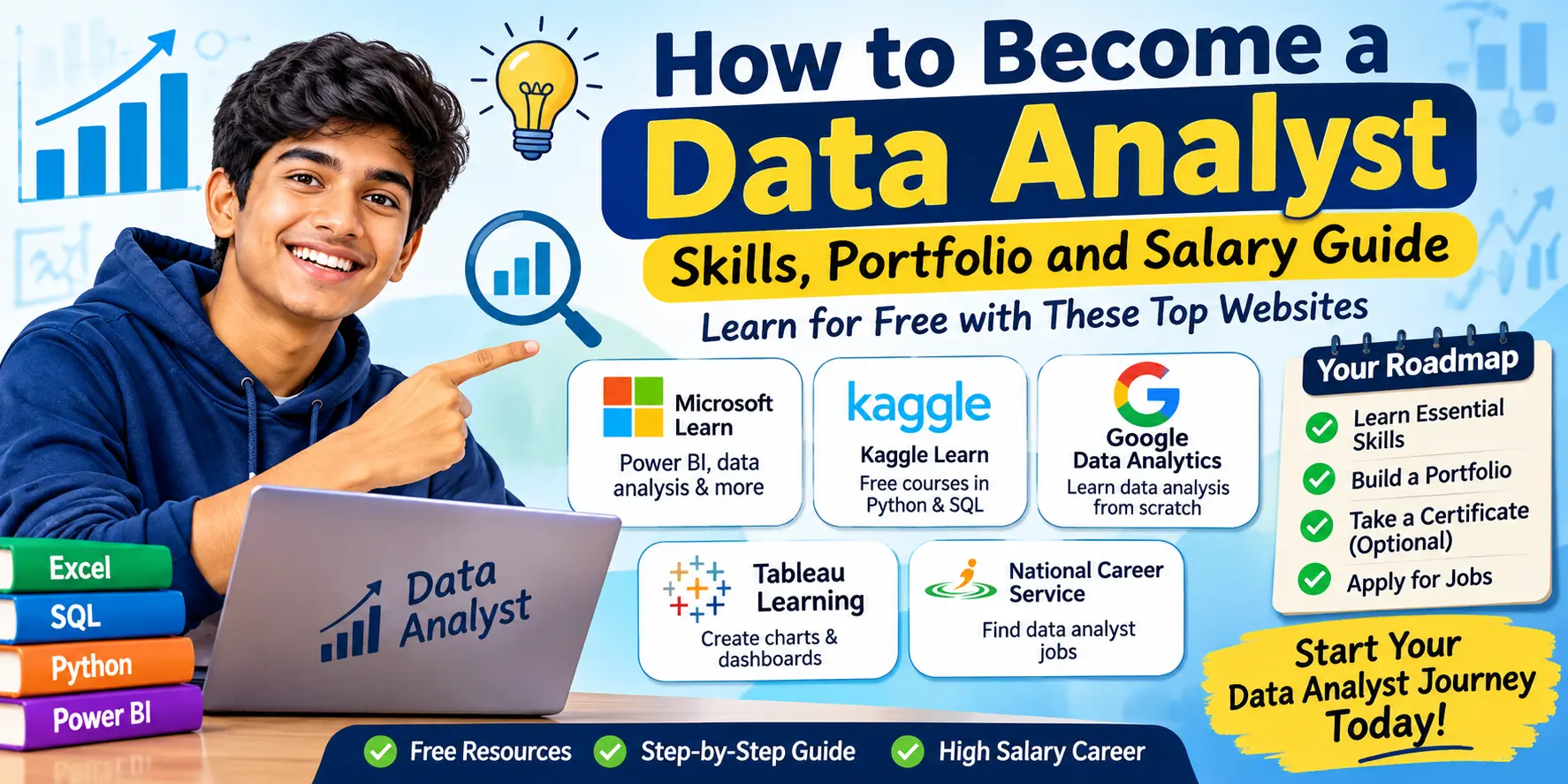
8. Free Websites Where You Can Learn Data Analysis
You do not have to spend a lot of money to start learning. Several websites offer free lessons.
Employee Learning and Training Platform | Microsoft Viva
Microsoft Learn
Learn Power BI, data cleaning and data analysis.Visit Microsoft Learn
How can I use the Kaggle API for my projects?
Kaggle Learn
Practise Python, SQL, data cleaning and data charts. Its listed short courses are free.Visit Kaggle Learn
Levels At Google Career at Brain Ervin blog
Google Data Analytics Certificate
Learn data cleaning, analysis, charts and how to explain results. The course is paid through Coursera in India after its free trial.Visit Google Data Analytics
Tableau Review: Features, Pricing, Pros and Cons
Tableau Learning
Learn how to make charts, reports and dashboards.Visit Tableau Learning
Kaggle offers free lessons in Python and SQL. Microsoft provides guided Power BI training. Tableau also has free learning videos. How to Become a Data Analyst.
These resources can help you understand How to Become a Data Analyst without paying for many courses.
9. Should You Get a Data Analyst Certificate?
A certificate can show that you have completed a course. It may also help you learn topics in the right order.
You can consider:
- Google Data Analytics Certificate.
- Microsoft Power BI Data Analyst Associate.
- Other trusted courses in Excel, SQL and Python.
Microsoft offers the Power BI Data Analyst Associate certification. It checks skills in preparing data, building data models and creating reports with Power BI.
But remember, a certificate alone cannot guarantee a job.
Employers may also test your Excel, SQL, problem-solving and communication skills. So, make projects while studying for a certificate. How to Become a Data Analyst.
10. How Long Does It Take to Become a Data Analyst?
The learning time depends on your starting level and daily practice.
If you study regularly, you may follow this example plan:
| Learning period | What to study |
|---|---|
| Month 1 | Excel and basic maths |
| Month 2 | SQL |
| Month 3 | Statistics and data charts |
| Month 4 | Power BI or Tableau |
| Month 5 | Python basics and pandas |
| Month 6 | Portfolio projects and job preparation |
This is an example, not a fixed promise. Some people may need more time. Others may learn faster if they already know Excel or programming.
Try to study for one to two hours each day if your schedule allows it. Practise what you learn instead of only watching videos.
You can start making small projects before you finish all the topics. This will help you understand How to Become a Data Analyst through regular practice.
11. Data Analyst Salary in India
Salary is one of the main things people want to know before choosing a career.
Your salary may depend on:
- Your skills.
- Your work experience.
- Your city.
- Your company.
- Your education.
- The type of work you do.
- Your ability to solve business problems.
A salary snapshot reported by Indeed and published by PW on 29 June 2026 showed these average yearly figures for India:
| Job level | Reported average yearly salary |
|---|---|
| Junior Data Analyst | Rs. 2,02,455 |
| Entry-Level Data Analyst | Rs. 5,15,010 |
| Data Analyst | Rs. 6,50,900 |
| Senior Data Analyst | Rs. 11,38,405 |
These figures were based on 973 reported salaries in the cited snapshot. They are not guaranteed salaries or fixed pay scales. Actual offers can be lower or higher. PW Live
A fresher may earn less than an experienced analyst. A person with strong SQL, Power BI, Python and business skills may qualify for better roles over time.
Do not choose a course only because someone promises a high salary. First build the skills that employers ask for.
12. Where Can You Find Data Analyst Jobs?
After learning the main skills and building your portfolio, start looking for jobs.
You can search for these job titles:
- Data Analyst.
- Junior Data Analyst.
- Associate Data Analyst.
- Business Analyst.
- Reporting Analyst.
- MIS Analyst.
- Operations Analyst.
- Power BI Analyst.
Some job titles have different duties. Read the job description before applying.
You can search on:
You can also visit company career pages. Look for internships, trainee jobs and entry-level roles.
Do not wait until you know every tool. Apply when you have the basic skills required for a job.
13. Prepare for Data Analyst Interviews
Before an interview, revise the topics you have learned.
Employers may ask questions about:
- Excel formulas and Pivot Tables.
- SQL queries and JOINs.
- Basic statistics.
- Data cleaning.
- Power BI or Tableau dashboards.
- Python basics.
- Your portfolio projects.
You may also get a small test. For example, the company may give you a sales file and ask you to find the best-selling product.
Practise explaining your work in simple words.
For every project, prepare answers to these questions:
- What was the main problem?
- Where did you get the data?
- Which tools did you use?
- What steps did you follow?
- What did you find?
- What would you suggest?
Do not claim that you know a tool if you cannot use it. Be honest about your skills and experience.
14. Common Mistakes Beginners Should Avoid
When learning How to Become a Data Analyst, try to avoid these mistakes:
- Learning too many tools together: Start with Excel and move forward slowly.
- Ignoring SQL: Many analyst jobs need SQL.
- Avoiding statistics: Learn the basic number topics.
- Only watching videos: Practise with real data.
- Making no projects: Build a portfolio to show your skills.
- Collecting certificates only: Learn how to use the tools.
- Ignoring communication: Practise explaining your results.
- Expecting a job in a few days: Give yourself enough time.
- Applying without checking job details: Read the required skills first.
- Giving up after a failed interview: Learn from your mistakes and try again.
15. Your Simple 6-Month Learning Plan
Here is a simple plan you can follow if you are starting from zero.
- Month 1: Learn ExcelStudy formulas, tables, sorting, filters, Pivot Tables and charts. Make one simple sales report.
- Month 2: Learn SQLPractise SELECT, WHERE, GROUP BY, ORDER BY and JOIN. Solve small questions every day.
- Month 3: Learn Basic StatisticsStudy averages, percentages, median, mode and basic charts. Practise using sample data.
- Month 4: Learn Power BI or TableauConnect data, clean it and make a dashboard. Learn how to explain the charts.
- Month 5: Learn Python BasicsStudy variables, lists, loops and functions. Then start using pandas for data work.
- Month 6: Build Your Portfolio and ApplyComplete three good projects. Put them in your portfolio. Update your resume and LinkedIn profile. Start applying for suitable jobs.
You can follow this plan at your own speed. If you need more time for one topic, take it. Learning well is more useful than rushing.
16. Can You Become a Data Analyst Without Experience?
Yes, you can start learning without work experience. But you must show employers that you can do the work.
You can build experience through:
- Personal projects.
- College projects.
- Internships.
- Volunteer work.
- Freelance projects.
- Practice tasks using public data.
Start with small projects. Then make more detailed reports as your skills improve.
If you are a fresher, show your projects clearly on your resume. Explain what you did and what you learned.
This is one of the most useful ways to understand How to Become a Data Analyst when you are starting your career.
17. What Can You Do After Becoming a Data Analyst?
After gaining experience, you may choose to move into other roles.
Some possible career paths are:
- Senior Data Analyst.
- Business Analyst.
- Business Intelligence Analyst.
- Data Analytics Consultant.
- Analytics Manager.
- Data Scientist.
- Data Engineer.
Each role needs different skills. For example, data science may need more statistics, programming and machine learning. Data engineering focuses more on building systems that move and store data.
You do not need to choose your future role now. First, learn the basics and gain work experience.
Final Words
How to Become a Data Analyst is a useful career topic for students, freshers and people who want to change their jobs.
Start with Excel. Then learn SQL, basic statistics and Power BI or Tableau. After that, learn Python and make real projects.
Build a portfolio with at least three good examples of your work. Update your resume and start applying for suitable jobs. Keep practising for interviews and improve your skills over time.
You do not need to learn everything in one month. Take one step at a time. With regular practice and patience, you can work towards becoming a data analyst.
Official Learning Websites
- Microsoft Learn – Data Analyst Training
- Kaggle – Free Learning Courses
- Google – Data Analytics Certificate
- Tableau – Free Learning Resources
- National Career Service – Job Search
Also Check Out:- IBPS RRB Clerk Prelims Admit Card 2026 Out: Download Call Letter for Office Assistant Exam
FAQs
1. How can you become a data analyst without experience?
You can start by learning Excel, SQL, basic statistics and Power BI or Tableau. You can also learn Python to work with larger amounts of data. Practise with free learning websites and public datasets. Create at least three projects, such as a sales report, customer report or website traffic report. Add these projects to your portfolio and use them when applying for entry-level data analyst jobs. How to Become a Data Analyst.
2. Which skills are needed to become a data analyst?
You should learn Excel or Google Sheets, SQL, basic statistics and a data visualisation tool such as Power BI or Tableau. Python is also useful for cleaning and studying data. You should also learn how to explain your findings through reports and charts. These skills will help you work with data and share useful results with a company. How to Become a Data Analyst.
3. What is the salary of a data analyst in India?
The salary depends on your skills, experience, company, job role and location. The salary figures discussed in this guide include around Rs. 2,02,455 per year for a junior data analyst, Rs. 5,15,010 for an entry-level data analyst, Rs. 6,50,900 for a data analyst and Rs. 11,38,405 for a senior data analyst. These are reported salary figures, not guaranteed salaries. How to Become a Data Analyst.
4. Which free websites can help you learn data analytics?
You can use Microsoft Learn to study data analysis and Power BI. Kaggle Learn offers lessons and practice exercises. Tableau provides learning materials for data visualisation. You can also use the National Career Service website to explore career information and job opportunities. The Google Data Analytics Certificate is another learning option, but it is a paid course after its trial period. How to Become a Data Analyst.
